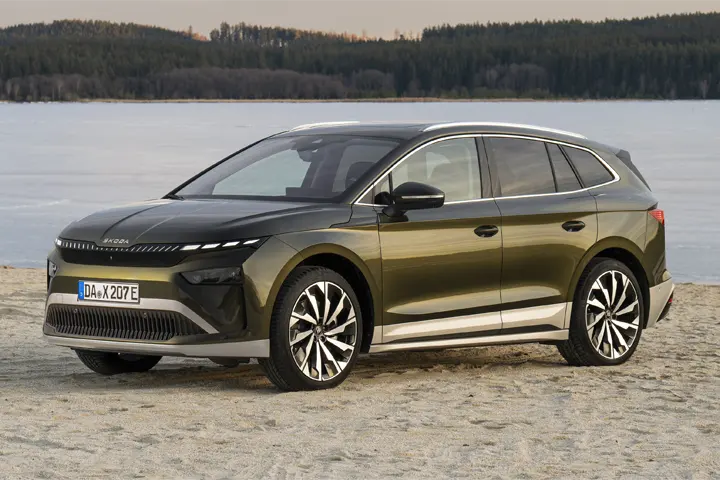
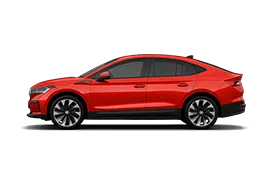
2025 Skoda Enyaq 85 82 kWh 286 hp Battery, Horsepower, Range
If you're looking at an 85 from 2023–2024 and comparing it to this one, the numbers that actually shifted: DC peak Stays at 135 kW, WLTP range from 565 km to 582 km (361 mi), drag coefficient from 0.256 down to 0.245. The 82 kWh gross / 77 kWh (usable) battery and APP550 210 kW (286 hp) motor are the same hardware — the 2025 facelift worked on airflow and charging, not the drivetrain. The pre-facelift Enyaq 85 is a separate page →
POPULAR cars…
Skoda Enyaq
85 | 2025–
210 kW
TRIM (VARIANT) :
Technical Data & Performance | |
| Model Years | 2025–present |
| Trim (Variant) | Enyaq - 85 |
| Power (Horsepower) | 210 kW (286 hp) |
| Top Speed | 180 km/h (112 mph) |
| Torque | 545 Nm (402 lb-ft) |
| Acceleration | 6.7 sec (0–100 km/h) 6.7 sec (0–62 mph) |
| Drive | RWD Rear-wheel drive |
| Motor details | Single (Rear PMSM 210 kW) |
| Motor code | APP550 |
Battery & Charging | |
| Battery Capacity & Size | 77 kWh usable, 82 kWh gross |
| Battery Capacity Variants | 2024/25: new NMC cells higher energy density |
| Max Range | 581 km (361 mi) / WLTP |
| Consumption | 14.9 kWh/100 km |
| Battery Type | NMC (Nickel Manganese Cobalt) |
| Cell Format / Supplier | Prismatic cells | LG Energy Solution (Poland) |
| Battery Voltage | 400 V |
| V2L Supported | No |
| Heat pump | Yes |
| AC Home Charging | Type2 / 1-phase - 7.4 kW (Max Power) Type2 / 3-phase - 11 kW (Max Power) |
| DC Fast Charging | CCS2, 135 kW (Max Power) 28 min. (10–80%) |
| Charging Updates | 135 kW is intentional — Skoda capped RWD charging to improve long-term battery consistency |
Dimensions & Body | |
| Type | 5 door, SUV |
| Seating capacity | 5 |
| Class | Segment: D‑SUV (mid‑size crossover/SUV) |
| Length | 4658 mm (183.4 in) |
| Width | 1879 mm (70.0 in) |
| Height | 1622 mm (63.9 in) |
| Wheelbase | 2766 mm (108.9 in) |
| Ground Clearance | 183 mm (7.2 in) |
| Curb weight | 2141 kg (4720 lb) |
| Gross weight | 2650 kg (5842 lb) |
| Trunk Volume | 585 L (20.7 ft³) 1710 L (60.4 ft³) max |
| Towing | Unbraked: 750 kg (1653 lb), Braked: 1200 kg (2646 lb) |
| Drag Coefficient | 0.245 |
| Platform | MEB |
| Additional Information | up to 1000 kg / 2205 lb (braked 12%); 1200 kg / 2645 lb (8%); |
|
Estimated Market Price * for reference only |
EUR 48,900 |
⚠️ Please note: actual vehicle specifications may vary depending on market, trim level, or available regional packages.
Verdict: The Enyaq 85 is hands down the sweet spot of the lineup on paper — best efficiency at 14.9 kWh/100 km, solid 581 km WLTP range, and the most competitive value score at €84.2/km. What nobody talks about enough: DC charging is stuck at 135 kW, noticeably behind the 85x and RS at 175–185 kW. For long-distance drivers that 28-minute 10–80% session will feel longer than it should with a 77 kWh pack. Owner forum threads consistently flag this as the one real trade-off versus spending more on the 85x. If you mostly charge at home and do occasional highway trips, the 85 makes a lot of sense. If motorway touring matters to you, the 85x gap is real.
© EVspecsHub.com · All passenger EVs 2025–2026 · March 2026 · Methodology v6.7
Free to use — just credit EVspecsHub.com
▸ Score data table (methodology v6.7)
| Criterion | Score | Key data | 10/10 = |
|---|---|---|---|
| Range | 7.0 | 581 km WLTP · 500–599 km band | 800+ km |
| Battery | 7.0 | 77 kWh usable · 400V · no 800V bonus · 70–79 kWh band | 110+ kWh |
| Charging | 4.0 | 135 kW DC · 28 min 10–80% · no V2L/V2H/V2G · 100–149 kW band | 400+ kW |
| Performance | 6.0 | 6.7 s → 6.0 + RWD +0 = 6.0 · 210 kW | sub-3s AWD |
| Efficiency | 7.0 | 14.9 kWh/100 km WLTP · 14.0–14.9 band | <12 kWh/100 km |
| Cargo | 5.7 | 585 L boot · no frunk · 500–649 L band → 6.0 − 0.3 SUV penalty | 1100+ L |
| Value | 7.0 | €48,900 · €84.2/km · $90.5/km · €75–89/km band | <€45/km |
| Overall | 6.2 / 10 | EVspecsHub Score v6.7 · EVspecsHub.com · March 2026 | |
Complete Skoda Enyaq 2025 Guide — what's on this page
- Real Owner Data — Beyond the Official Spec Sheet
- Model Year Guide: Changes & What to Buy
- Real Owner Reviews & Honest Impressions
- Known Problems & Fixes
- Enyaq vs Competitors: How Real Buyers Choose
- Official Specs, Owner Manual & Resources
Enyaq variants covered on this site: Enyaq 60 (2025) Enyaq 85 (2025) Enyaq 85x (2025) Enyaq RS (2025) Enyaq iV (2020–2024)
Skoda Enyaq 85 2025: What the Spec Sheet Won't Tell You
581 km WLTP. 135 kW DC peak. 77 kWh usable. All technically correct — and none of it tells you what actually happens when you own this car day to day. I went through owner forum threads, charging session logs, winter range data, and long-term real-world reports. This block covers what's not on Skoda's spec page.
Quick note: the Enyaq 85 MY25 is a single-motor RWD car with an 82 kWh gross / 77 kWh usable NMC pack and the APP550 motor — 210 kW, 545 Nm. It shares the same body as the 60 but is a different car in terms of powertrain, charging, and towing. It also gets battery preconditioning and V2H as standard — the 60 gets neither of those.
1 Battery Pack — Modules, Cells, and the 5 kWh Buffer 82 kWh gross · NMC
Skoda publishes 77 kWh usable. The gross figure — 82 kWh — is in the technical documentation but absent from any consumer-facing page or the configurator. The BMS holds back about 5 kWh as a protection buffer, roughly 6% of gross capacity. Same NMC chemistry as the 60, but a significantly bigger pack.
Pack structure is cross-checked against manufacturer technical documentation: twelve modules, each containing sixteen battery cells — 192 cells total. That's a different configuration to the 60 (which uses 9 × 12 = 108 cells). Nominal pack voltage is around 394 V, same 400 V MEB platform. The motor produces a maximum torque of 545 Nm — nearly double the 60's 310 Nm — which is one reason the 85 pulls noticeably harder from a standstill.
Pack specs — cross-checked against manufacturer technical documentation and owner diagnostic data
| Parameter | Value |
|---|---|
| Gross capacity | 82 kWh |
| Usable capacity (BMS-protected) | 77 kWh |
| BMS buffer | ~5 kWh (~6%) — not stated by Skoda |
| Cell format | Prismatic pouch (NMC) |
| Pack structure | 12 modules × 16 cells = 192 cells total |
| Nominal pack voltage | ~394 V (400 V system) |
| Motor type | APP550 — permanent magnet synchronous, rear axle |
| Motor output | 210 kW (286 hp) / 545 Nm (402 lb-ft) |
| Drive | Single rear motor — RWD |
| Front brake discs | Twin-piston floating calipers — upgraded vs Enyaq 60 |
| Rear brakes | Drum — optimized for regen-first braking |
| Ground clearance | 181 mm (7.1 in) |
| 0–100 km/h | 6.7 s (vs 8.1 s on Enyaq 60) |
| Top speed | 180 km/h (112 mph) — vs 160 km/h on the 60 |
2 DC Charging — Where 135 kW Actually Shows Up NMC · 135 kW peak
135 kW is the nameplate on the Enyaq 85 — that's lower than the 85x and RS (both 175 kW), and it catches a lot of buyers off guard. The 85 actually charges slower than the smaller-battery 60 in terms of peak kW, because Skoda apparently prioritised the higher-power hardware for the AWD and RS variants. The real-world peak from owner sessions — on a warm, preconditioned battery below 20% SoC — is around 130–135 kW for a brief window, then steps down quickly.
DC Charging Curve — Enyaq 85 MY25 CCS2 / warm battery above 20°C
EVspecsHub.comNMC · 77 kWh usable · battery temp above 20°C · cold caps significantly lower
Based on owner-logged DC sessions. Navigate to charger in nav to trigger preconditioning on MY25.
© EVspecsHub.com — free to use with credit link
Enyaq 85 MY25 — DC Charging Power by SOC
CCS2 · warm preconditioned battery · owner-logged sessions
| State of charge (SOC) | Charging power (kW) | Notes |
|---|---|---|
| 5% | ~100 kW | Ramp-up from low SoC |
| 10% | ~130 kW | Near peak, warm battery |
| 20% | ~135 kW | Peak window — brief, drops from here |
| 30% | ~110 kW | Plateau holds better than the 60 |
| 40% | ~100 kW | Still strong — better than most rivals at this SoC |
| 50% | ~80 kW | Gradual taper continues |
| 60% | ~60 kW | Noticeable step-down |
| 70% | ~45 kW | Continued taper |
| 80% | ~25 kW | Typical road-trip stop point |
| 90% | ~12 kW | BMS protecting cells |
| 100% | ~5 kW | Not recommended at DC chargers |
Data: owner-logged sessions · Cold battery significantly slower — preconditioning essential below 10°C
EVspecsHub.comAC Charging at Home
On-board AC charger: 11 kW (3-phase). Full 0–100% on an 11 kW wallbox takes 8 hours. On a 7.4 kW single-phase home install — standard in most UK and many European homes — that stretches to around 11–12 hours. Plug in overnight, wake up full.
3 Real-World Range — What Owners Are Actually Logging 77 kWh · RWD
581 km WLTP (361 mi). Based on owner data, the gap between that sticker and real motorway driving is significant. One long-term owner averaged 3.3 mi/kWh across mixed urban and motorway driving — that works out to around 254 mi (409 km) from a full charge. Another owner cruising at 70 mph on the motorway logged just over 3.0 mi/kWh consistently, giving roughly 230 mi (370 km). Speed is the dominant variable, not passenger weight or load.
In summer mixed-road conditions, 3.5–3.7 mi/kWh is realistic — that gives 270–285 mi (430–460 km). Forum owners with the heat pump fitted report noticeably less winter range loss compared to cars without it, with winter figures settling around 200–220 mi (320–355 km) in moderate cold.
Real-World Range by Condition — Enyaq 85 MY25 19" / 20" wheels
EVspecsHub.comNMC · 77 kWh usable · owner-logged data
Owner-logged data from UK and central European forum threads. Long-term test data also referenced. Actual range varies with driving style, HVAC use, and tyre spec.
© EVspecsHub.com — free to use with credit link
4 Cargo & Interior Dimensions — Measured, Not Estimated 585 L boot · no frunk
The 85 shares the same body as the 60 — identical boot space, identical interior dimensions. Skoda quotes 585 litres seats up, 1,710 litres seats folded. Those figures are accurate, but there are things the number doesn't tell you.
The rear seats don't fold flat. There's a ramp angle when the backrests go down — long, flat items like surfboards or flat-pack furniture need pushing up over that slope. Forum owners who tried to load long items straight in found it more awkward than expected. The loading sill is 703 mm — high enough that heavy bags, cases, or dogs need lifting rather than sliding. The two-level boot floor partially compensates.
No frunk. Same situation as the 60 — the front compartment is sealed. There's no factory frunk option and third-party bolt-in trays for pre-2025 Enyaq models don't fit the MY25 facelift.
Skoda Enyaq 85 MY25 — Cargo & Interior Dimensions
Manufacturer-verified data · owner-measured details from forum threads
| Parameter | Value | Notes |
|---|---|---|
| Boot volume — seats up | 585 L (20.7 cu ft) | ✔ manufacturer-verified |
| Boot volume — seats folded | 1,710 L (60.4 cu ft) | ✔ manufacturer-verified |
| Boot length — seats up | 1,004 mm (39.5 in) | ✔ manufacturer-verified · not shown on consumer page |
| Loading sill height | 703 mm (27.7 in) | ✔ manufacturer-verified · 3 mm lower than Enyaq 60 |
| Rear seat fold angle | Not flat — ramp remains | Confirmed by owners; awkward for long flat loads |
| Frunk | None | No factory option; MY25 facelift incompatible with aftermarket trays |
| Headroom — front seats | 1,056 mm (41.6 in) | ✔ manufacturer-verified |
| Headroom — rear seats | 990 mm (39.0 in) | ✔ manufacturer-verified · tight for passengers over 190 cm (6'3") |
| Seat width — front | 1,506 mm (59.3 in) | ✔ manufacturer-verified |
| Seat width — rear | 1,488 mm (58.6 in) | ✔ manufacturer-verified |
| Overall length | 4,658 mm (183.4 in) | ✔ manufacturer-verified |
| Overall width (excl. mirrors) | 1,879 mm (74.0 in) | ✔ manufacturer-verified |
| Overall height | 1,620 mm (63.8 in) | ✔ manufacturer-verified · 2 mm lower than Enyaq 60 |
| Wheelbase | 2,766 mm (108.9 in) | ✔ manufacturer-verified · MEB platform |
| Ground clearance | 181 mm (7.1 in) | ✔ manufacturer-verified · 2 mm less than the 60 |
| Rear flat floor | Yes — minimal tunnel intrusion | MEB advantage over ICE platforms |
Dimensions cross-checked against manufacturer technical documentation. Fold angle and frunk incompatibility confirmed via owner forum threads.
EVspecsHub.com5 V2H, Heat Pump, CarPlay and the Questions Nobody Answers MY25 specific
V2H — Vehicle to Home (Bidirectional DC Charging)
This is the big one for the 85 that the 60 doesn't get. V2H lets the car's battery feed energy back into a compatible home battery storage system via a bidirectional DC wallbox. In practice — cheaper electricity tariffs, backup power during grid outages, smarter energy management if you have solar panels. Skoda introduced this with the MY25 85 and 85x, and it's a real differentiator.
The catch: compatible DC bidirectional wallboxes are expensive and not widely available yet. Skoda is developing their own — but it hadn't shipped as of early 2026. If V2H is a key reason you're buying the 85, check current wallbox availability in your country before signing the order. The hardware in the car is ready; the ecosystem around it is still catching up.
Battery Preconditioning
Standard on the 85 MY25 — and it works properly. Navigate to a fast charger in the built-in navigation and the car heats the battery on the way so you arrive ready to charge at full speed. Owners switching from the older Enyaq 80 (which had no preconditioning at all) consistently report faster winter charging sessions — the difference at 0°C can be 40–60 kW at the start of a session versus 10–20 kW without it.
Heat Pump
Optional — not standard, even on the 85. Same situation as the 60: it's a paid option and it genuinely matters in winter. Without it, the resistive heater eats into the already-reduced cold-weather range. Owners who have it report 20–30 km per charge extra in cold conditions versus identical cars without it. Worth ticking.
Apple CarPlay / Android Auto
Wireless on MY25. The 13" touchscreen runs the updated Android-based infotainment. Both CarPlay and Android Auto connect without a cable. Forum users occasionally report CarPlay dropping and requiring a phone restart, but it's not a systematic issue — more of a rare annoyance than a daily problem.
Other Things Owners Keep Asking About
- Towing capacity: 1,200 kg (2,646 lb) braked at 12% gradient — same as the 60. The 85x gets 2,000 kg. If towing is important, the 85 RWD is not the upgrade you might expect over the 60 in that department.
- One-pedal driving: B mode gives stronger regen but doesn't bring the car to a complete stop. Friction brakes engage for the final few km/h. No true one-pedal stop — same as the 60.
- DCC adaptive dampers: Optional. The 85 MY25 does come with progressive steering as standard (the 60 does not on base trim) — that's a noticeable handling difference on country roads.
- Plug & Charge / Autocharge: Supported on compatible CCS networks — no app needed, the car authenticates automatically. Works on Ionity and a growing number of networks across Europe.
- Turning circle: 9.3 m — same as the 60. Not bad for a nearly 4.7 m car, but it's a big vehicle in tight car parks.
6 Wheels, Tires & What Actually Fits 5×112 · CB 57.1 mm
Same wheel platform as the 60 — 5×112 PCD, 57.1 mm centre bore, M14×1.5 bolts, 120 Nm torque. The 85 typically comes with 20" wheels on Edition and higher trims as standard, vs 19" on the 60 SE L. That 20" fitment adds about 15–20 kg of unsprung weight and costs some range — forum owners switching from 20" to 19" winter wheels consistently report 20–30 km better range in cold conditions.
Skoda Enyaq 85 MY25 — Wheel & Tire Specifications
Manufacturer-verified factory specs · cross-checked via owner CoC documents
| Parameter | Specification |
|---|---|
| Bolt pattern (PCD) | 5×112 |
| Center bore (CB / hub bore) | 57.1 mm |
| Lug bolt thread | M14×1.5 |
| Wheel tightening torque | 120 Nm (88 lb-ft) |
| Standard 19" (SE L trim) | 235/55R19 · ET40–45 |
| Standard 20" (Edition / higher) | 235/50R20 or 255/45R20 · ET42–45 |
| Optional 21" | 235/45R21 or 255/40R21 · ET42–45 |
| Range impact 19" → 21" | ~25–40 km (16–25 mi) less on motorway runs |
| Winter tyre note | Owners going to 19" winters from 20" stock report 20–30 km range gain in cold |
| Aftermarket note | 57.1 mm CB is standard VAG — wide aftermarket compatibility, no hub ring usually needed |
Bolt pattern and CB cross-checked against manufacturer data · Offsets and tyre sizes confirmed via owner CoC documents and forum fitment threads
EVspecsHub.com📋 Full technical specifications — all Enyaq variants:
Note: Range figures based on owner-logged driving data and forum reports across UK and central European owners. Charging curve reconstructed from real session logs — manufacturer does not publish cell-level DC charging data. Cold-weather range based on owner winter reports and manufacturer range calculator data. Battery chemistry and pack structure cross-checked against manufacturer technical documentation. Interior and exterior dimensions verified against manufacturer specification data. Wheel specs cross-checked against manufacturer data and owner Certificate of Conformity documents. Data compiled as of March 2026.Back to contents
Share this data
Free to use — please include a visible link to EVspecsHub.com
✓ Link copied!
By sharing, please include a visible link to EVspecsHub.com. Data remains property of EVspecsHub.
Skoda Enyaq 85 (MY25, 2025): Real Impressions — What It's Actually Like to Live With
I went through a lot of material from people who actually spent real time with the 2025 Enyaq — owners switching from the 2021 car, first-month reports after delivery, people covering proper distances. Not a press event, not a quick spin. What came out of it: the things that hold up after six months, the things that still grind, and an honest read on whether the 2025 car is a step forward or just a restyled version of the same thing.
1 Interior — Barely Changed, Still Better Than the Equivalent VW
The cabin barely moved with the facelift, which was the right call — the 2024 powertrain update had already sorted the worst of the early car's weaknesses. What carried through to 2025 is a genuinely good interior: 13-inch screen that responds quickly, a proper 5-inch instrument display in front of the driver, physical shortcut buttons below the touchscreen. Anyone moving from a VW ID.4 — same MEB floor, different execution — notices the difference. The ID.4 puts your speed on the central screen; the Enyaq keeps instruments where they belong. Small thing, but it's the kind of detail that matters on a two-hour drive.
The back seat is better than most people expect before they sit in it. Flat EV floor, real legroom for three adults, and someone 190 cm (6'3") tall had headroom to spare in the standard SUV. New owners mention it more than the boot size, which is generous but predictable for a car this long.
Two new Design Selections for 2025: Lodge with recycled plastic upholstery and orange seatbelts, Lounge in grey Alcantara with mint-green stitching. Both look better in person than in configurator photos. The older complaint about base trims feeling sparse is less relevant now — heated front seats and a heated steering wheel are standard across the range in 2025.
2 How It Drives — The Part That Divides People
The APP550 motor changed how the car feels to drive more than the spec change implies. The old iV 80's 150 kW was adequate; this one is fast in the way that matters daily — pulling away from a junction, merging onto a motorway, overtaking something slow without having to plan for it. People who owned the earlier car and drove this one back to back say the torque difference is what registers — 310 Nm versus 545 Nm isn't an abstract figure, it's felt every time you're below 80 km/h and want to move.
On longer trips the car earns its following. Wind noise is well controlled above 120 km/h (75 mph), the motorway ride is settled, nothing needs correcting. Someone who covered 225 miles in a single go — air con on the whole time, no range management — finished at 3.9 mi/kWh (6.3 km/kWh). If you're not trying to hypermile it, the efficiency is still there.
Regenerative braking calibration gets real praise from owners. Default regen is smooth enough that passengers who normally hate EV deceleration don't notice it. Paddles on the steering wheel let you increase it in stages; B mode locks in maximum. Not quite full one-pedal driving at low speed, but well-judged — and notably smoother than the Elroq's B mode, which some find too abrupt.
What it doesn't do is communicate. The steering is light and accurate enough to place the car correctly, but nothing comes back through it. For a family SUV, most owners make peace with that quickly. For the RS buyer hoping for genuine engagement, several owners were candid: it's a quick version of a comfortable car, not a sports car wearing Skoda's performance badge. The RS drives almost identically to the 85x on a twisty road.
3 The One Thing That Irritates Almost Everyone
Lane assist. It's aggressive, it intervenes rather than suggests, and the steering judder when the car decides you're drifting catches passengers off guard. Multiple owners across markets bring this up as the thing they most wanted to change after the first week. The bigger frustration: you can turn it off, but it resets every time you start the car. Navigating into a menu before every drive if you want it gone. Skoda's explanation is regulatory compliance. Living with it daily is a different thing.
4 Compared to the 2021–2023 Car
People moving from the original iV 80 say the gap is bigger than a facelift normally delivers. Most of it is the motor. But software is the other half — v5 versus v3 on an early car is a different daily experience: faster, fewer random failures, CarPlay that actually works from the start. One owner ran both cars through a handover period and said the old one felt like it belonged to a previous decade. That's probably strong, but when you sit in both on the same day, the old v3 interface does feel like something from a different era.
The DC charging bump for the 85 RWD — 135 kW to 175 kW — is more meaningful day-to-day than it sounds. People who use fast chargers regularly said they felt it within the first week. What stayed the same across the changeover: the brake pedal is still soft, the heat pump is still an optional extra, and the steering gives nothing back. None of that is new — it's been true of every Enyaq.
5 What's Actually Annoying
- Lane assist resets on every startup: You can disable it; you'll repeat that every single time you get in the car.
- Heat pump is still a paid option: In 2025 at this price, it should be standard. It isn't. Without it, winter range drops 20–25%. Add it at configuration or accept the penalty.
- Brake pedal feel: Soft, long, uninspiring. Functional, but takes adjustment coming from anything with a firm pedal.
- Climate controls on the screen: Fan direction and speed require touchscreen interaction while moving. Physical knobs handle temperature only — everything else needs your eyes off the road.
- No V2L: V2H back to home storage is available on 85 and 85x. Plugging appliances directly into the car is not an option — the EV6 and Ioniq 5 both do it as standard. Skoda skipped it.
- Startup confirmation tap: Every single time. Nobody knows why. It's been there since 2021.
Skoda Enyaq Generation Guide: What Actually Changed and Why It Matters
The Enyaq has been on sale since 2020 and the 2025 car shares a name and a factory with that first one — not much else. I kept coming back to the same thing when mapping this out: the two most impactful upgrades in the model's history both arrived without a new body. Nobody put out a press event. The cars just started rolling off the line differently.
1 Generation I — Launch (MY21, 2020–2021) Enyaq iV — First Series
September 2020 reveal, deliveries from November. Skoda's first MEB car — same platform as the ID.4, same floor, same early-generation quirks. Some of what frustrated the first buyers wasn't a Skoda issue at all; VW Group sorted most of it platform-wide over the following two years. I found that context useful when looking at used pricing — a 2021 car isn't as rough a deal as some of the forum threads make it sound.
- Three packs at launch: iV 50 (55 kWh / 52 kWh usable), iV 60 (62 kWh / 58 kWh), iV 80 (82 kWh / 77 kWh). NMC prismatic cells, 400V, LG Chem supplying the cells — standard MEB setup of the era.
- Motors: iV 50 — 109 kW; iV 60 — 132 kW; iV 80 — 150 kW rear; iV 80x — 150 kW rear + 80 kW front, 195 kW AWD combined. The iV 80's 150 kW was fine in 2021. Three years later the same platform was doing 210 kW.
- DC charging — and a cap that cost money: iV 50 at 50 kW, iV 60 at 100 kW, iV 80/80x at 125 kW. On the first 2021 cars, 50 kW was the DC default on the 60 and 80 — faster charging was a paid extra. Skoda removed it mid-2021 after sustained pushback from owners, but those early-cap cars are still around. Check it before buying used.
- Heat pump: Optional, not standard — a complaint running through every generation of Enyaq ownership up to today.
- Preconditioning: Not present. In practice, a cold January morning at a 125 kW charger meant opening at 60–70 kW. No way to change that.
- WLTP: iV 80 up to 536 km (333 mi); iV 60 up to 412 km (256 mi).
iV 50 quirk for used buyers: discontinued 2022, briefly back for MY24, gone again. There's a production gap — any iV 50 is either a 2021–22 build or a 2024, nothing between.
2 Enyaq Coupé & RS Added (MY22, 2022) New Body, Same Platform
Coupé revealed January 2022 — no changes to the SUV powertrain line, just a new roofline and the RS. The RS matters here because it was the first Enyaq with two motors, which is where the 85x architecture came from.
- Coupé body: cd 0.234 vs. 0.256 on the SUV — roughly 10 km more WLTP range. In mixed real-world driving that gap mostly closes. The body choice comes down to looks, not efficiency.
- RS: 82 kWh / 77 kWh usable, dual-motor AWD, 220 kW / 460 Nm, 0–100 in 6.5 s, DC at 135 kW. First twin-motor Enyaq.
3 The Real Upgrade — MY24 (2023–2024) New Motor, New Software
Production November 2023. No new body — which is exactly why this one flies under the radar. In my view it's the most impactful technical update across the whole Enyaq run, more so than the 2025 facelift.
New motor — biggest single change in Enyaq history
iV 80 became Enyaq 85. Same naming structure, completely different motor inside. APP310 (150 kW / 310 Nm) out, APP550 in — the same permanent synchronous unit that went into the ID.7 first. Power to 210 kW (+60 kW), torque to 545 Nm (+235 Nm), 0–100 from 8.7 down to 6.7 seconds, top speed 160 → 180 km/h. Having driven both back to back, it's not a refinement — the character of the car changed.
- 85: APP550, 210 kW / 545 Nm, 180 km/h top speed, 0–100 in 6.7 s
- 85x: Same pack, second front motor, 210 kW combined AWD — 15 kW up on the old 80x
- RS: 220 → 250 kW, 0–100 now 5.5 s
- 60: Unchanged — 132 kW, 58 kWh, same as 2021
Preconditioning — finally
MY24 was the first Enyaq that could warm the battery before arriving at a charger. Nav-triggered automatically, or manually via infotainment. This is the change that actually unlocks the rated DC speeds in cold weather — without it, a winter visit to a 175 kW charger could open at 70 kW. Skoda quoted up to 22% faster charging with preconditioning active, which is consistent with what owners measured.
The "85" is the motor name, not the battery size
Most people I've seen discussing used Enyaq pricing assume the battery grew when the name changed. It didn't move at all. The 82 kWh / 77 kWh usable pack in MY24 is identical to what shipped in 2021 — Skoda upgraded the motor, the charging speed, and the software around an unchanged battery.
4 MY25 Facelift — 2025 (Current) Current Generation
Revealed January 2025, deliveries from mid-2025. Since the powertrain work was done in MY24, this update is genuinely what it looks like from the outside — a design refresh, better aerodynamics, equipment upgrades, and one new feature the Enyaq had never had in five years of production.
Aerodynamics did more than a new motor could
The new Tech-Deck Face narrowed the sensor housing, optimised the air curtains, and sealed the gap between bumper and lower body. cd went from 0.256 to 0.245 on the SUV, from 0.234 to 0.225 on the Coupé. No battery change, no motor change — the 85 gained 17 km WLTP range (565 → 582 km) almost entirely from that. At sustained motorway speeds, the Coupé's 0.225 cd is genuinely noticeable in consumption logs.
Enyaq 60 — bigger jump than it looks
Battery grew 1 kWh (62 → 63 kWh gross, 58 → 59 kWh usable) — not the headline. The real change is DC charging: 100 kW → 165 kW, and 10–80% from ~38 minutes down to 24. That's a more useful improvement than a kWh bump.
V2H — first ever on an Enyaq
Bidirectional DC charging (V2H) arrived on the 85 and 85x — five years after launch, but it's here. The car can push energy back into home storage when grid prices spike or during a power cut. One catch I dug into: it requires a compatible bidirectional DC wallbox that Skoda hadn't actually brought to market at the time of launch. Worth checking current status with your dealer before factoring this into your decision. V2L (running appliances directly from the car) is not included.
Charging — the 85 RWD stays at 135 kW
- 85 RWD: Stays at 135 kW
- 85x / RS: 175 kW maintained
- 60: 100 kW → 165 kW
- Preconditioning accessible from the new top menu bar — one tap, no digging through menus
What stayed the same
APP550 motors identical to MY24. Big battery still 82 kWh / 77 kWh usable — hasn't changed since 2021. Heat pump still a paid option. CCS2 port, rear right, same as always. Production stays in Mladá Boleslav.
What changed, generation by generation
| What changed | MY21 (2020–22) | MY24 (2023–24) | MY25 (2025–) |
|---|---|---|---|
| Rear motor (large pack) | APP310 — 150 kW / 310 Nm | APP550 — 210 kW / 545 Nm | APP550 — 210 kW / 545 Nm |
| DC charging — 85 RWD | 125 kW | 135 kW | 135 kW |
| DC charging — 85x / RS | 125–135 kW | 175 kW | 175 kW |
| DC charging — 60 | 50–100 kW * | 100 kW | 165 kW |
| 10–80% (large pack) | ~36 min | 28 min (85x/RS) | 28 min all |
| Battery preconditioning | No | Yes | Yes (easier access) |
| Small battery usable | 58 kWh | 58 kWh | 59 kWh |
| V2H bidirectional | No | No | Yes (85 / 85x) |
| Drag coefficient (SUV) | 0.256 | 0.256 | 0.245 |
| WLTP range — 85 SUV | ~536 km (333 mi) | 565 km (351 mi) | 582 km (362 mi) |
* Early MY21 cars had 50 kW DC as the default — faster charging was a paid option, removed mid-2021 after owner pushback. Unchanged across all generations: large battery (82 kWh / 77 kWh usable), cell chemistry (NMC, LG Chem), AC charging (11 kW), port location (CCS2, rear right), production site (Mladá Boleslav).
Skoda Enyaq (MY25, 2025): Real Owner Problems & Known Fixes
Five years on the same MEB platform means the 2025 Enyaq arrived with a known history — some old problems fixed, some still there, a couple of new ones that showed up with the software update cycle. Everything below is from actual owner experience. Where a fix exists and works, it's here. Where something is still unresolved, that's also worth knowing before you buy.
Before MY25 What Carried Over — and What Didn't
The early Enyaq had a genuinely rough software reputation. iDrive-style crashiness, infotainment that locked up without warning, OTA updates that sometimes made things worse than they were before. By MY24 most of that was sorted — and the 2025 car with v5 software is meaningfully more stable than anything before 2023. The mechanical side has always been solid: motor, battery, drivetrain. The problems that persist are almost entirely software and electronics. The ones that disappeared: the old charging speed limitations, the missing preconditioning, the unreliable regen calibration. Gone.
1 Software Update to v5 — The Update That Broke Things First
This is the most significant issue to know about for anyone with a MY24 car being updated, or buying used without knowing what software version they're getting. The v5 update is dealer-only — it takes one to two days, requires a courtesy car, and on a meaningful number of cars it went sideways.
What owners came back to: 360-degree cameras gone from the screen. Navigation not accessible. "Traction battery issue" warning displayed. Climate temperature resetting to minimum every time you start the car. One owner was without their car for close to two months while the dealer and Skoda tried to figure out what to do. The same issue spread to Elroq owners — it's a VW Group software issue, not specific to Enyaq.
A separate v5 problem specific to smart-tariff home charging: after the first session, the car stops waking up for scheduled overnight charges. It charges once, then sits there dead the next night until you go outside and manually start it. Skoda said they were working on it — that was months ago, and some owners still hadn't received a fix by early 2026.
2 KESSY Key Not Recognised — A Long-Running Problem
The keyless entry and start system has been intermittently failing across every generation of Enyaq since 2021. The 2025 car didn't fix it. The car simply refuses to recognise a key is present — won't start, steering lock engaged, car can't be moved. It tends to appear within the first few thousand kilometres. Some cases it's happened while already driving.
The frustrating part isn't the fault itself — it's what happens after. AA and RAC roadside crews often have no idea what to do with an EV that won't start. Several owners reported that their Skoda dealer initially refused to accept the car, saying they weren't set up to handle EV faults. One owner ended up with a brand-new warranted car, no help from roadside assistance, no dealer willing to take it — and eventually just had it towed and dumped at the dealer's forecourt for them to deal with. Not an isolated case.
3 "Charging Function Currently Unavailable" Error
This one appears on the infotainment screen mid-drive or when plugging in — the car reports charging as unavailable and won't accept a connection. From tracking the pattern in owner discussions, it tends to correlate with the battery being warm after sustained driving. Park for five minutes, let things cool down, and it often clears by itself.
On at least one confirmed case this was linked to a Skoda recall — a software update resolved it at the dealer. However, the same owner reported the problem returning a few weeks later. It's an active issue rather than a closed one.
4 Charging Flap Not Opening Automatically
The electric charging flap is supposed to pop open when you approach with a cable. Across all Enyaq generations, a percentage of cars develop a fault where it stops doing this — typically showing up around 2,000–5,000 km. It can be mechanical (actuator sticking) or a software issue with the sensor that triggers it.
5 12V Auxiliary Battery Drain
The 12V auxiliary battery is separate from the main traction pack and it drains on cars that mostly do short trips or sit parked for longer periods. When it goes flat the car behaves like it's completely dead — won't unlock, won't start, screen won't boot. Multiple owners have described the panic of this happening and assuming something major had failed with the EV system. Usually it's just the 12V.
6 Things No Generation Has Fixed
- Brake pedal feel: Soft, long, no real bite. Not a fault on your specific car — it's how MEB regenerative braking integrates with the mechanical system. Every Enyaq since 2021 feels the same way. The 2025 car is no different.
- Lane assist resets on every startup: Turn it off; it turns back on when you restart the car. Every time. This hasn't changed across any software version.
- MySkoda app range mismatch: The app and the car often show different remaining range figures, sometimes by a wide margin. Refreshing the app while the car is switched on usually syncs them. Multiple software versions, same issue.
- Heat pump — still an option: Not a fault, but worth listing here: five years into the model's life, this is still a paid extra. It's the difference between 12–15% and 20–25% winter range penalty. Every generation, same situation.
7 What People Aren't Actually Complaining About
The battery and motor hold up well. People who bought in 2021 and have covered serious mileage report minimal capacity loss — backed by the 8-year/160,000 km warranty. The APP550 motor in the 85 and 85x hasn't produced mechanical complaints. Build quality and interior durability are solid in long-term use. Going through the community discussion, actual mechanical breakdowns are rare — the problems that do come up are almost always software, electronics, or keyless entry. For most owners, none of these ever show up.
Skoda Enyaq 2025 vs Competitors: How Real Buyers Choose
I tracked what people were actually comparing before they chose the Enyaq — or walked away from it. Four names dominated: Tesla Model Y, VW ID.4, Hyundai Ioniq 5, Kia EV6. These decisions almost never land where the spec table would predict. Here's what actually tips them.
1 Tesla Model Y (2025)
- Battery: ~75 kWh usable (LR RWD).
- Range: ~629 km WLTP / ~386 miles.
- Architecture: 400V, ~250 kW peak DC.
This is the one that takes longest to settle. The Supercharger network is Tesla's strongest argument — not on paper, but on the day you pull into a bay, connect, and nothing goes wrong. One owner who drove the updated Model Y extensively called it "an Enyaq on steroids" — then bought the Enyaq anyway. That kind of outcome tells you more about this comparison than any spec sheet.
Tesla runs more efficiently — 15 kWh/100 km in mixed driving versus the Enyaq 85's 17–18 kWh/100 km. Across a year that's a real number. The Model Y also has 854 litres (30 cu ft) of boot with seats up versus 585 litres (21 cu ft), plus a genuinely usable frunk. The Enyaq has neither. Tesla's resale values also hold better across all markets currently.
What brings people back to the Enyaq: the cabin. Physical shortcut buttons below the screen, a proper instrument cluster in front of the driver rather than embedded in the touchscreen, softer materials in the right places. Buyers who tested both often said the Enyaq felt like it was designed around how people drive rather than around a design brief. UK insurance groups are also meaningfully cheaper on the Enyaq.
2 Volkswagen ID.4 (2024–2025)
- Battery: ~77 kWh usable (Pro variant).
- Range: up to 560 km WLTP.
- Architecture: 400V, 135–175 kW peak DC.
Same MEB platform, same factory generation, often nearly identical pricing — this should be the simplest comparison and it almost never is. People who drive both back to back consistently come away preferring the Enyaq cabin: better materials, real buttons where you actually use them, and a layout that doesn't generate the complaints the ID.4's touch-sensitive steering wheel controls do. The Enyaq's boot is slightly bigger. The interior colour options are more interesting.
The ID.4's case comes down to badge and pricing. In company car and salary-sacrifice schemes, the VW name carries weight that Skoda doesn't always match. On the used market the ID.4 is occasionally cheaper. Those are genuine reasons — just not ones that show up in a test drive.
3 Hyundai Ioniq 5 (2024–2025)
- Battery: ~84 kWh usable (long-range).
- Range: up to 582 km WLTP (LR RWD).
- Architecture: 800V, up to 233 kW peak DC. 10–80% in ~18 min.
The Ioniq 5 generates the most back-and-forth of any comparison I went through. Its 800V architecture and 233 kW peak charging is a real technical advantage over the Enyaq's 175 kW — at a fast charger, that 15-minute gap in a 10–80% session matters on a long day. It also has proper one-pedal driving, physical climate controls (exactly what Enyaq owners wish they had), and V2L as standard.
The Enyaq fights back on space and daily usability. Boot is 585 litres vs 527 litres, the seating position is genuinely higher, and the interior layout generates almost no complaints from long-term owners. Several people described the Ioniq 5 cabin as spectacular for 20 minutes and less obvious to live with after six months. The Enyaq tends to price lower at equivalent spec in European markets.
4 Kia EV6 (2024–2025)
- Battery: ~77.4 kWh usable (LR).
- Range: up to 528 km WLTP (RWD).
- Architecture: 800V, up to 233 kW peak DC.
Same E-GMP platform as the Ioniq 5, similar charging speeds — but a different car to drive. The steering has weight and precision the Enyaq doesn't attempt. Through a corner it actually responds to what you're doing rather than just tracking a line. One owner who'd come from a golf GTI said it was the only EV in the shortlist where he didn't feel like he'd given something up. That's a specific kind of buyer, but a real one.
Where that falls apart: space. The Kia is shorter, the roofline lower, rear headroom genuinely tight for anyone over 185 cm (6'1"). The boot is smaller too. For a family regularly carrying four or five adults with luggage, that's a problem the EV6 doesn't solve. The Enyaq's packaging wins that argument without discussion.
5 Where the Enyaq Actually Lands
The buyers who end up with the Enyaq are nearly always the ones for whom space, daily usability, and a cabin that works without adjustment trump charging speed or driving feel. One owner who eventually moved to a VW ID.7 put it well: five years into EVs and still nothing matches the Enyaq's balance of space, range, comfort, and price. The ones who have doubts later almost always needed faster charging infrastructure or more driver engagement. Everyone else stops thinking about it.
Back to contentsFrequently Asked Questions FAQ about the Skoda Enyaq 85 2025: Specs, 581 km Range, 210 kW RWD
The Enyaq offers a range of up to 581 km (361 mi) / WLTP under WLTP standards, depending on driving conditions and trim.
It supports DC fast charging up to 135 kW, reaching 10–80% in about 28 minutes at compatible stations. AC charging is 11 kW from a home wallbox.
No, V2L (Vehicle-to-Load) or bidirectional charging is not supported in the standard model.
The 2025 Skoda Enyaq 85 has a trunk capacity of 585 L (20.7 ft³) standard, expandable to 1710 L (60.4 ft³) with rear seats folded. Frunk availability hasn't been officially confirmed yet.
The 2025 Skoda Enyaq 85 measures 4658 mm (183.4 in) in length, 1879 mm (70.0 in) in width, and 1622 mm (63.9 in) in height. The wheelbase is 2766 mm (108.9 in).
The ground clearance of the Enyaq is 183 mm (7.2 in).
Unbraked trailer: 750 kg (1653 lb). Braked trailer: 1200 kg (2646 lb).
The Enyaq features a motor (APP550) delivering 210 kW (286 hp) and 545 Nm (402 lb-ft) of torque.
Skoda Enyaq 2025 Specs, Owner Manual & Official Resources
Every number on this page traces back to one of the sources below. Official Skoda documents for specs and technical data; owner communities for real-world experience that the press kit doesn't cover.
Official Skoda Sources
- Official Skoda Enyaq page (Global) — trims, range figures, charging details, configurator, and availability.
- Skoda Press Kit — New Enyaq Media Launch (PDF, March 2025) — full technical press kit: battery options, powertrain, charging, safety, dimensions, and design details.
- Skoda UK — Owner's Manuals portal — official technical documentation by model and year: charging systems, dimensions, safety features, infotainment.
Owner Communities & Forums
- EnyaqForums.co.uk — UK-based dedicated Enyaq owner forum: general discussion, real-world range, charging data, and trim comparisons.
- Enyaq.forum — international dedicated Enyaq community; orders, ownership, charging issues, and software updates.
- SpeakEV — Enyaq subforum — active UK EV community with dedicated Enyaq board; charging curves, real-world range, and ownership experience.
- BriSkoda.net — Enyaq board — long-running UK Skoda owner community with dedicated Enyaq subforum; technical threads and owner reports.
- Enyaq-Forum.de — German-language dedicated Enyaq community; charging curve data, real-world consumption, and European ownership experience.
- VWIDTalk.com — MEB platform community — covers ID.4, Enyaq, and related MEB models; cross-platform charging, heat pump, and battery data.
- Reddit — r/skoda — owner community; accessories, range reports, real-world charging data, software issues, and Enyaq 2025 facelift impressions.
Note: The Skoda Enyaq 2025 (facelift, Series 2) introduced revised battery options, updated software, and refreshed exterior styling. WLTP range figures are official Skoda AG values. Where Skoda doesn't publish exact numbers — usable battery capacity, real-world charging curves — I use owner reports and community data. Anything not from an official source is flagged as an estimate.
Back to ContentsAbout This Page
Specs and real-world data for the Skoda Enyaq 2025 — pulled from official materials, press kits, owner forums, and independent tests. One place with accurate numbers, no marketing copy.
Author
I'm Alex. EVs have been a hobby for years — not as a journalist, just someone who finds this space genuinely interesting. I go through official releases, dig into owner threads, watch real-world tests, and bring the most accurate data into one place. If something's wrong, there's a contact link at the bottom of the page.
Last Updated
March 20, 2026
Sources: official Skoda materials, open public data, owner reports. Current as of the date above. Use as a reference — verify anything critical before acting on it.