
2021 Ford Mustang Mach-E Select RWD - Standart Range 75.7 kWh 266 hp Battery, Horsepower, Range
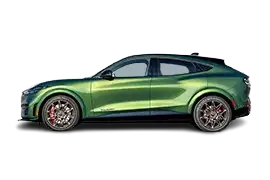


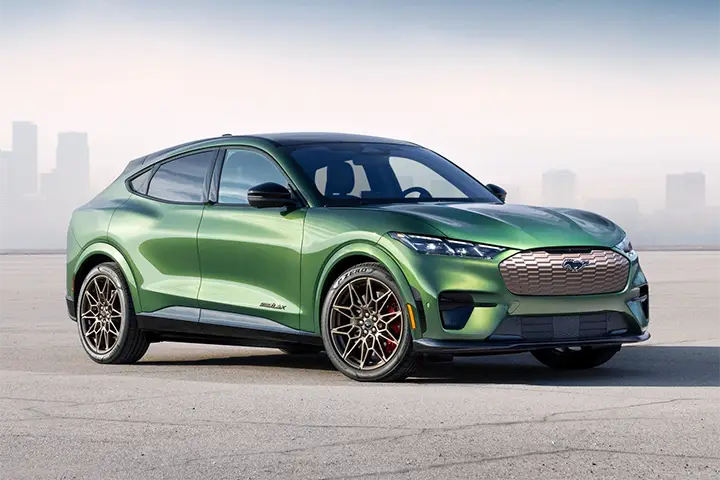



Ford Mustang Mach-E (2021–2024): Real Range, Charging & Battery — What Owners Actually Measured
Ford quotes 300 miles (483 km) EPA range and a 38-minute 10–80% charge. I've spent time going through what owners actually measured — OBD logs, timed charging sessions, cold-weather range tests people ran themselves and posted in detail. This section isn't the press kit. It's what comes after you've owned the car for a winter.
Two battery sizes ran across this generation: Standard Range (SR) at 68–72 kWh usable, Extended Range (ER) at 88–91 kWh usable. From mid-2023, SR switched from NCM to LFP chemistry — they behave differently at the charger and in the cold. Numbers below specify which pack they refer to.
1 Battery Pack — Two Chemistries, Real Capacity Numbers All trims
Nobody at Ford will tell you the usable capacity number. You have to dig for it. What people found: early SR cars run LG pouch NCM cells, 75.7 kWh gross, somewhere between 68 and 70 kWh you can actually use. Peak DC around 115 kW, about 38 minutes to go 10–80%. The July 2023 switch to CATL LFP changed things noticeably — prismatic cells, 347.8V pack, 108 cells in series, 72 kWh usable, and suddenly the SR hits 150 kW peak and does 10–80% in 33 minutes. The catch is weight. LFP is dense in a bad way — an SR AWD LFP ends up weighing almost as much as an ER AWD despite carrying 26% less energy.
How to tell which chemistry your car has: LFP window sticker reads "72KWH USABLE STD LFP BATT." The owner manual confirms: 8th VIN digit 4 or 5 = LFP, digit 1 = NCM. Matters for daily charge targets — LFP can go to 100% regularly without harm, NCM is better kept at 80–90%.
Extended Range: NCM throughout
ER packs stayed NCM pouch cells the whole run. Early gross was 98.8 kWh; from 2023 usable is rated at 91 kWh. At low SOC the pack briefly accepts ~159 kW (around 1.6C), but it doesn't hold that rate for long — more on that in the charging section.
✅ LFP owners: charge to 100% at least once a month. Unlike NCM, LFP actually needs a periodic full charge to recalibrate the BMS — skip it long enough and the range estimator starts drifting. Ford's own documentation says this. For daily use 80% is fine, just don't avoid 100% entirely.
2 DC Fast Charging — The Curve, The Drop-Off, The Fine Print ER NCM
The ER pack's original charge curve was the single biggest complaint on owner forums, and honestly the frustration was fair. At launch it peaked at 159 kW briefly at the very bottom of the range, held 106–112 kW from 7–27%, dropped to 95–97 kW around 31–37%, then settled into a wide flat 76–80 kW plateau from 40% all the way to 77% — and then fell to 11–12 kW above 80%. Not a taper. A wall.
Ford pushed a dealer-installed recall update (21P22) that improved post-80% behavior — owners started seeing 40–45 kW at 81–85% instead of the original cliff. A later OTA in 2023–2024 smoothed the overall curve further; 10–80% sessions came down to 38–39 minutes on verified owner logs. The average power from 20–80% works out to about 84 kW — 53% of the headline peak, which is the number that actually matters for road trips.
DC charging curve — Mach-E ER NCM (2023–2024 software, 91 kWh usable)
150 kW+ CCS charger, warm pack (~77°F / 25°C). Owner-logged sessions.
Cold pack sessions (below 14°F / -10°C) open at 70–90 kW — the pack warms itself during charging and speed recovers, but you lose 8–12 minutes on a timed 10–80% session.
▸ Data behind this chart
| SOC | Power (kW) | Notes |
|---|---|---|
| 10% | ~150 kW | Brief ~159 kW overboost possible |
| 20% | ~108 kW | 106–112 kW plateau |
| 30% | ~96 kW | 95–97 kW band |
| 40% | ~88 kW | Wide flat section |
| 50% | ~85 kW | 2024 software holds better here |
| 60% | ~80 kW | Still near plateau |
| 70% | ~72 kW | Gradual taper begins |
| 80% | ~42 kW | Post-update (was 11–12 kW at launch) |
| 90% | ~20 kW | Slow, not worth waiting for |
| 100% | ~8 kW | Don't do this at a public charger |
⚠ No battery preconditioning on early builds. The 2021 Mach-E didn't precondition the battery before DC charging unless you navigated to a charger — and even then it was inconsistent. I've seen owners document 70–90 kW opening speeds on cold packs vs. 130–150 kW on preconditioned ones at the same charger. That gap is 8–12 minutes on a 10–80% session. Later software helped, but first-year cars got the short end of this one.
3 Real-World Range — What Owners Are Actually Logging ER RWD / ER AWD
EPA Combined for the ER RWD is 300 miles (483 km). That number is achievable — at 60 mph in mild weather with a light load. Change any variable and it moves fast. The chart below is built from actual logged drives, not manufacturer estimates.
Real-World Range by Speed & Conditions — Mach-E ER RWD (91 kWh usable, 80% charge limit)
60 mph (97 km/h), mild
~290 mi (467 km)
70 mph (113 km/h), mild
~245 mi (394 km)
75–80 mph (121–129 km/h)
~200 mi (322 km)
Mixed city + highway
~265 mi (426 km)
Winter 70 mph, 10–14°F (-12–-10°C)
~148 mi (238 km)
Extreme cold -35°F (-37°C)
~125 mi (201 km)
Owner-logged data, 18–19" wheels, 80% charge limit. AWD cuts range ~15–20 mi (24–32 km) vs. RWD under the same conditions.
▸ Data behind this chart
| Speed / scenario | Range (miles) | Range (km) | Conditions |
|---|---|---|---|
| 60 mph (97 km/h) | ~290 mi | ~467 km | 50°F (10°C), open road |
| 70 mph (113 km/h) | ~245 mi | ~394 km | Mild, highway |
| 75–80 mph (121–129 km/h) | ~200 mi | ~322 km | Typical US interstate |
| Mixed city + highway | ~265 mi | ~426 km | Daily commute, ~50°F (10°C) |
| Winter 70 mph, 10–14°F (-12–-10°C) | ~148 mi | ~238 km | Heat on full, 80% charge |
| Extreme cold -35°F (-37°C) | ~125 mi | ~201 km | Canadian winter, sustained highway |
What those numbers actually feel like
Most people on US interstates are doing 70–80 mph whether they admit it or not. At those speeds you're looking at somewhere between 200 and 245 miles (322–394 km) per charge stop, not the 300 on the sticker. One guy in New Jersey actually tracked this properly — three 800-mile round trips at 68 mph, 3.7 to 4.1 mi/kWh (2.3–2.6 km/kWh) each way, one stop per 400-mile leg. Genuinely impressive. Add a passenger, luggage, 78 mph, and that same car drops to 2.4–2.6 mi/kWh. You start thinking about stops every 200 miles (322 km) instead.
Winter is a different conversation entirely. One owner in Canada planned a 188-mile (303 km) drive at -35°F (-37°C), logged everything carefully, and had to stop anyway — 1.5 to 1.7 mi/kWh (0.9–1.1 km/kWh) average, nearly half the battery going to heat rather than forward motion. That's an extreme case but not a freak one. More commonly, at 10–14°F (-12 to -10°C) with the heat running on a highway, owners are logging around 2.1 mi/kWh. Charge to 80% and that's about 148 miles (238 km). Write that number down before a winter road trip, not the EPA one.
The one thing that actually moves the needle: pre-warming the cabin while the car is still plugged in. That resistive heater draws 5+ kW from the outlet, not the battery. Skip it and those first 15–20 miles (24–32 km) are gone before you even leave your street.
📋 Full technical specifications by variant:
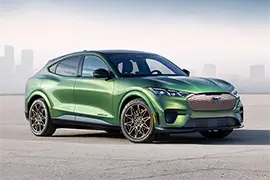
Select RWD (SR)
Select AWD (SR)
Premium RWD (ER)
Premium AWD (ER)
California Route 1
GT AWD
GT PE AWD
Rally AWD
Note: Mach-E launched as a 2021 model (deliveries from late 2020). SR NCM packs were replaced by CATL LFP from July 2023 production; ER NCM ran through 2024. Charging curve data is from owner-logged sessions on 150 kW+ CCS hardware with a warm pack — cold starts open significantly lower. EPA figures are US values; European WLTP figures differ. Data compiled March 2026.Back to contents