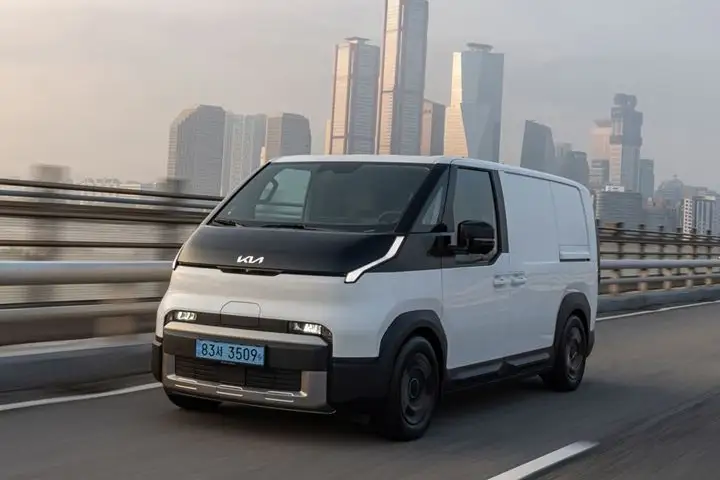
2025 Kia PV5 Cargo 43.3 kWh 43.3 kWh 161 hp Battery, Horsepower, Range







EVspecsHub Score — Kia PV5 Cargo 43.3 kWh LFP (2025)
Independent rating vs all passenger EVs on sale 2025–2026
Range
~240 km est. WLTP · LFP 43.3 kWh · not yet confirmed by Kia
4.0
weak
Battery
43.3 kWh · LFP chemistry · voltage not published · no V2G
4.0
weak
Charging
150 kW DC max · 10–80% in 30 min · no V2L/V2H/V2G standard
5.0
avg
Performance
0–100 km/h est. 16+ s · FWD · 89.4 kW · commercial van
2.0
weak
Efficiency
~19.0 kWh/100 km est. WLTP · tall van body · official figure not published
3.0
weak
Cargo
4,400 L load volume · 4.4 m³ · L2H1 body · no frunk
10.0
top
Value
~€33,000 · ~$35,600 · ~€137.5/km · ~$148.5/km WLTP est.
4.0
weak
Verdict: The 43.3 kWh LFP scores where it was built to score: Cargo hits 10.0 — 4,400 litres of load space that no passenger EV comes close to. Charging holds at 5.0 with 150 kW DC. The 4.6 reflects honest positioning on a universal EV scale: range and efficiency both land in the weak band, but this van was built for urban depot-to-depot routes with a full daily LFP charge, not for cross-country runs. Figures valid for cars built from June 2025.
© EVspecsHub.com · All passenger EVs 2025–2026 · April 2026 · Methodology v6.7
4.6
out of 10
EVspecsHub Score
📊 Using this score in your review?
Free to use — just credit EVspecsHub.com
Free to use — just credit EVspecsHub.com
▸ Score data table (methodology v6.7)
| Criterion | Score | Key data | 10/10 = |
|---|---|---|---|
| Range | 4.0 | ~240 km est. WLTP · 200–299 km band · not confirmed | 800+ km |
| Battery | 4.0 | 43.3 kWh LFP · 40–49 kWh band · no 800V bonus | 110+ kWh |
| Charging | 5.0 | 150 kW DC · 150–199 kW band · no V2L/V2H/V2G standard | 400+ kW |
| Performance | 2.0 | est. 16+ s FWD · 89.4 kW · 10+ s band | sub-3s AWD |
| Efficiency | 3.0 | ~19.0 kWh/100 km est. · 18.0–19.9 band | <12 kWh/100 km |
| Cargo | 10.0 | 4,400 L load volume · 4.4 m³ L2H1 · 1100+ L band | 1100+ L |
| Value | 4.0 | ~€33,000 · ~€137.5/km · €130–159/km band · range est. | <€45/km |
| Overall | 4.6 / 10 | EVspecsHub Score v6.7 · EVspecsHub.com · April 2026 | |
Kia PV5 Cargo 43.3 kWh LFP: The Fleet-First Battery That Changes the Charging Rules
43.3 kWh. LFP chemistry. The entry variant of the PV5 Cargo lineup — and the only one with Lithium Iron Phosphate cells. That single chemistry choice changes the entire ownership experience: charge to 100% every day without worrying about pack degradation, expect better cycle life than the NCM variants above it, and trade some range for a lower purchase price and simpler fleet management. I went through all available Kia documentation to pull together what's actually confirmed versus what's still pending for this variant. Figures valid for cars built from 2025.
Quick note before we get into specs: as of Q1 2026, Kia has not published WLTP range, motor output or AC charge time specifically for the 43.3 kWh variant in any accessible European press documentation. The October 2025 Guinness World Records press release described this variant as "forthcoming." The UK spec sheet (August 2025) covers only 51.5 kWh and 71.2 kWh variants. We're being upfront about this rather than filling gaps with guesses. Where data exists it's confirmed — where it doesn't, we say so. Note: some searches use "43.5 kWh" — the correct figure is 43.3 kWh per Kia's official press release.
1 Battery Pack — LFP Chemistry, Why It Exists, and What It Changes vs. NCM Variants 43.3 kWh · LFP · FWD
Short answer: The PV5 Cargo 43.3 kWh uses Lithium Iron Phosphate (LFP) chemistry — the only LFP variant in the entire PV5 lineup. Both Passenger variants (51.5 and 71.2 kWh) and the two larger Cargo variants (51.5 and 71.2 kWh) all use NCM. LFP is confirmed in the Kia Corporation press release from October 2025.
LFP was chosen for the entry Cargo for reasons that make sense for fleet operators. LFP cells have a flatter voltage curve and superior cycle life — typically 2,000–3,000 full cycles to 80% capacity versus 1,000–1,500 for comparable NCM packs. For a delivery van doing one full charge cycle per day, that's 5–8 years of daily cycling before the pack drops to 80%. The trade-off is lower energy density — 43.3 kWh in the same space costs more weight efficiency than NCM would — and a lower nominal voltage, which affects peak charging power.
Pack specs — confirmed from Kia official documentation
| Parameter | 43.3 kWh LFP | 51.5 kWh NCM (reference) |
|---|---|---|
| Gross capacity | 43.3 kWh | 51.5 kWh |
| Cell chemistry | LFP — Lithium Iron Phosphate | NCM — Nickel Cobalt Manganese |
| Nominal pack voltage | tbc — not published by Kia | 290 V |
| Cell capacity (Ah) | tbc — not published by Kia | 177.01 Ah |
| Battery weight | tbc — not published by Kia | 283 kg |
| Motor output | tbc — not published by Kia | 120 kW / 89.4 kW |
| Max torque | tbc — likely 250 Nm | 250 Nm |
| Platform | E-GMP.S — shared across all PV5 variants | |
| Drivetrain | FWD — 1-speed automatic | |
| Cycle life advantage | ~2,000–3,000 cycles to 80% | ~1,000–1,500 cycles to 80% |
✅ LFP daily charge rule — opposite of NCM: LFP chemistry benefits from regular 100% charges. Unlike the NCM variants where daily charging to 100% accelerates degradation, LFP is designed to be charged to 100% every day. For fleet depot charging, this simplifies operations — no charge limit management, no 80% cap needed. Just plug in, charge full, drive.
⚠ Pending data: Motor output, nominal voltage, battery weight, exact payload figures and WLTP range for the 43.3 kWh variant are not published in any official Kia European documentation available as of Q1 2026. This page will be updated as Kia publishes full specifications at commercial launch.
★ Why LFP for the Entry Variant — the Fleet Logic
I went through the PV5 product positioning carefully and the LFP choice makes sense from a fleet procurement standpoint. Fleets buying entry vans for urban delivery routes — typically 80–150 km per day — don't need the range of the 51.5 or 71.2 kWh NCM variants. What they need is predictable cycle life, low total cost of ownership, and simple charging. LFP delivers all three. The 43.3 kWh pack, once range is confirmed, will almost certainly cover a full urban delivery shift with buffer. The NCM variants are better suited to operators needing longer range between charges or operators doing mixed urban and regional routes.
For second-hand buyers: LFP packs in fleet use age very gracefully compared to NCM. A fleet van with 100,000 km on a daily-charge LFP pack will typically retain more capacity percentage than an equivalent NCM van. When buying used, check the battery state-of-health report from Kia e-Care service records — this is one of the items covered in Kia's annual EV service plan.
2 DC Charging — 150 kW Peak, LFP Charge Curve, and the 100% Daily Rule 150 kW DC · LFP flat curve
Short answer: Kia confirms all PV5 Cargo battery variants — including the 43.3 kWh LFP — charge 10–80% in under 30 minutes at 150 kW DC. AC charge time for the 43.3 kWh is not published in available documentation. At 11 kW AC, a rough estimate based on pack size suggests approximately 4 hours for a full 10–100% charge.
LFP has a notably different charge curve from NCM — flatter through the mid-range but with a steeper drop-off approaching 100%. The good news is that LFP actually handles charging to 100% better than NCM from a cell stress perspective, so the curve's behaviour near full charge is less of a concern. Based on E-GMP.S platform behaviour on LFP cells (observed on related Kia models), expect the 43.3 kWh to hold near-peak DC power through the 20–60% window, then taper more sharply from 70% upward than the NCM variants do.
DC Charging Curve — Kia PV5 Cargo 43.3 kWh LFP 2025 150 kW max · warm battery · LFP
EVspecsHub.comPreliminary estimated curve based on LFP chemistry behaviour and E-GMP.S platform data. Will be updated with owner-logged sessions as they become available.
Kia PV5 Cargo 43.3 kWh LFP — DC Charging Power by SoC
Estimated · LFP chemistry · 150 kW charger · warm battery above 20°C
| State of Charge | Charging Power (kW) | Notes |
|---|---|---|
| 10% | ~120 kW | LFP ramp-up — slower than NCM initially |
| 20% | ~145 kW | Near peak — LFP plateau begins |
| 30% | ~148 kW | LFP flat plateau — characteristic of chemistry |
| 40% | ~148 kW | Plateau holds — LFP advantage vs NCM taper |
| 50% | ~145 kW | Still very strong mid-range |
| 60% | ~130 kW | Gradual taper begins |
| 70% | ~95 kW | LFP taper accelerates above 70% |
| 80% | ~55 kW | 10–80% completes in ~30 min — Kia confirmed |
| 90% | ~25 kW | Steeper LFP drop-off near full |
| 100% | ~10 kW | LFP safe to charge to 100% daily |
Estimated from LFP chemistry behaviour. Key LFP difference: flat plateau 20–60%, steeper drop above 70% vs NCM. Safe to charge to 100% daily. Figures valid for cars built from 2025.
EVspecsHub.comAC Charging
AC charge time for the 43.3 kWh variant is not listed in the UK specification document — that document covers only 51.5 kWh and 71.2 kWh. Based on pack size and an 11 kW onboard charger (consistent across the Cargo range), a rough estimate is approximately 4 hours for 10–100%. This is shorter than the 51.5 kWh's 4 hours 45 minutes — smaller pack, same charger speed. For fleet depot overnight charging on 7 kW single-phase, estimate around 6 hours. Both windows comfortably cover an overnight depot charge cycle.
3 Real-World Range — What to Expect Without Official WLTP Data WLTP: tbc · LFP
Short answer: Kia has not published a WLTP range figure for the 43.3 kWh Cargo variant in any European press documentation available as of Q1 2026. The 297 km WLTP figure cited in the SOLUTRANS November 2025 press release refers to the 51.5 kWh "standard battery" variant — not the 43.3 kWh. Applying the WLTP consumption rate of 190 Wh/km from the 51.5 kWh to the 43.3 kWh pack gives an estimated ceiling of approximately 228 km — but this is a calculation, not a confirmed figure.
★ The 297 km vs 43.3 kWh confusion is widespread. I went through the SOLUTRANS press release text carefully — it specifically says "the recently launched L2H1 Cargo delivers up to 297 kilometres with the standard battery." In Kia's lineup at that time, "standard battery" meant 51.5 kWh. The 43.3 kWh was still described as "forthcoming" in the October 2025 Guinness record release. If you see 297 km attributed to the 43.3 kWh anywhere, that's a misattribution.
⚠ WLTP range not confirmed: No official WLTP figure for the 43.3 kWh LFP has been published by Kia as of Q1 2026. The estimated ~228 km ceiling is based on applying the 51.5 kWh consumption rate to the smaller pack — it should be treated as a rough planning estimate only, not a confirmed specification.
Estimated Range by Condition — Kia PV5 Cargo 43.3 kWh LFP 2025 215/65R16 · WLTP pending
EVspecsHub.comAll figures are estimates — WLTP range for 43.3 kWh LFP is not officially confirmed by Kia as of Q1 2026. Estimates based on 190 Wh/km consumption from 51.5 kWh variant applied to 43.3 kWh pack. Will be updated on official confirmation.
Kia PV5 Cargo 43.3 kWh LFP — Estimated Range by Condition
Estimates only · WLTP range not officially published · 190 Wh/km basis
| Condition | Range (km) | Range (mi) | Notes |
|---|---|---|---|
| WLTP estimated ceiling | ~228 km | ~142 mi | Not confirmed — calculation only |
| Urban delivery, mild, light load | 185–200 km | 115–124 mi | Regen benefit in stop-start |
| Daily at 100% (LFP safe) | 185–200 km | 115–124 mi | Charge to 100% daily — no penalty |
| Mixed load, mild weather | 160–175 km | 99–109 mi | Moderate payload impact |
| Near-max payload, mild | 145–165 km | 90–103 mi | 790 kg payload (3-door) |
| Cold, below 0°C | ~130–150 km | ~81–93 mi | LFP more cold-sensitive than NCM |
All estimates — not confirmed specs. WLTP range will be added when Kia publishes official figures. Note: 297 km WLTP cited elsewhere refers to the 51.5 kWh NCM variant, not this 43.3 kWh LFP. Figures valid for cars built from 2025.
EVspecsHub.com4 Cargo Area Dimensions — Full L2H1 Measurements 4.4 m³ · 2,255 mm long
Short answer: Cargo area dimensions are identical to the 51.5 kWh and 71.2 kWh Cargo variants — the battery chemistry difference doesn't affect load space. 2,255 mm long × 1,565 mm wide above wheelarches × 1,520 mm tall, 4.4 m³ total. Rear step height 419 mm (16.5 in). All confirmed from the Kia UK specification document.
Cargo area and exterior dimensions — Kia UK specification (August 2025)
| Dimension | mm | inches |
|---|---|---|
| Cargo floor length | 2,255 mm | 88.8 in |
| Width — between wheelarches | 1,330 mm | 52.4 in |
| Width — above wheelarches | 1,565 mm | 61.6 in |
| Cargo height | 1,520 mm | 59.8 in |
| Rear step height | 419 mm | 16.5 in |
| Rear opening width (twin / single) | 1,343 mm / 920 mm | 52.9 in / 36.2 in |
| Side door opening width | 775 mm | 30.5 in |
| Side boarding height | 399 mm | 15.7 in |
| Total cargo volume | 4.4 m³ | |
| Overall length | 4,695 mm | 184.8 in |
| Width (excl. mirrors) | 1,895 mm | 74.6 in |
| Height | 1,923 mm | 75.7 in |
| Wheelbase | 2,995 mm | 117.9 in |
| Min. turning circle | 5.5 m | 18.0 ft |
Payload for the 43.3 kWh variant is not separately stated in available documentation — the published figures (790 kg 3-door / 745 kg 4-door) are listed against the 51.5 kWh SR in the UK spec. Given the LFP pack will almost certainly weigh less than the NCM 51.5 kWh pack (LFP has lower energy density and typically higher pack weight per kWh, but the smaller 43.3 kWh total could balance out), payload may be similar or slightly higher than the SR NCM. This will be confirmed when Kia publishes full LFP specifications.
📋 Also on EVspecsHub — Kia PV5 Cargo lineup:

5 Heat Pump, V2L Availability and Feature Breakdown by Grade V2L: Plus only · Heat pump: OPT
The 43.3 kWh LFP shares the same grade structure and feature availability as the other Cargo variants. The chemistry difference doesn't unlock or remove any features — it's purely a powertrain decision.
V2L
V2L is available on Plus grade only — not on Essential. The Plus grade includes a 3-pin power socket in the cargo area for V2L use. Based on the platform documentation, output is expected to be 3.68 kW, consistent with other PV5 variants. For the 43.3 kWh pack, V2L draws down a smaller reserve — plan accordingly for sustained off-grid use. With roughly 35 kWh available at full charge (allowing some buffer), you're looking at around 14 days of light camping draw (2.5 kWh/day) — less than the NCM variants but still practically useful for overnight or weekend use.
Heat Pump
Optional on Plus grade, not available on Essential. For the LFP variant, the heat pump argument is particularly strong in cold climates: LFP cells are more sensitive to low temperatures than NCM, meaning winter range loss can be more pronounced. A heat pump reduces HVAC load significantly and partially compensates. Operators running the 43.3 kWh in Scandinavia, Germany or the UK in winter without a heat pump should plan for range in the 130–150 km range on cold days — which is tight for a full delivery shift if routes approach that distance.
Grade Feature Comparison
| Feature | Essential | Plus |
|---|---|---|
| V2L (3-pin socket in cargo area) | — | ✓ |
| Heat pump | — | OPT |
| Heated front seats + steering wheel | — | ✓ |
| Blind-Spot Collision-Avoidance Assist | — | ✓ |
| Rear Cross Traffic Collision Avoidance | — | ✓ |
| Electric folding mirrors | — | ✓ |
| Wireless phone charger | — | ✓ |
| Highway Driving Assist (HDA) | ✓ | ✓ |
| Lane Following Assist 2 (LFA 2) | ✓ | ✓ |
| Wireless CarPlay / Android Auto | ✓ | ✓ |
| 12.9" screen + 7.5" driver display | ✓ | ✓ |
| OTA updates | ✓ | ✓ |
| 7-year Kia Connect services | ✓ | ✓ |
6 Wheels, Tyres, Payload and Service 215/65R16 · LFP cycle advantage
Short answer: 215/65R16 on 16-inch steel wheels — standard across all Cargo grades. Payload figures for the 43.3 kWh specifically are pending official publication. PCD not officially published — 5×114.3 probable from E-GMP.S platform pattern, owner confirmation needed. Service interval 24 months / 20,000 miles. 7-year vehicle warranty, 8-year battery warranty with 70% capacity minimum.
Wheel and service specs
| Parameter | Value / Status |
|---|---|
| Tyre size | 215/65R16 — confirmed |
| Rim type | 16" steel with full-size cover |
| PCD (bolt pattern) | 5×114.3 — probable, pending confirmation |
| Centre bore | tbc — not published |
| Tightening torque | tbc — not published |
| Max braked trailer weight | 750 kg — confirmed range-wide |
| Max roof load | 100 kg (220 lb) |
| Min. turning circle | 5.5 m (18.0 ft) |
| Service interval | 24 months / 20,000 miles |
| Vehicle warranty | 7 years / 150,000 km |
| Battery warranty | 8 years — min. 70% capacity retention |
| GVW | 2,650 kg — confirmed all variants |
| Payload (3-door) | tbc for LFP — 790 kg confirmed for 51.5 kWh SR |
The 8-year battery warranty on the LFP variant deserves specific mention. LFP chemistry inherently degrades more slowly than NCM under normal fleet use conditions — a van doing daily full charges on LFP will typically retain more than the 70% minimum threshold well past the warranty period. The warranty floor of 70% capacity is almost certainly conservative for LFP in urban delivery use. For fleet procurement, this translates to a lower residual risk on battery replacement costs over the vehicle's operating life.
📋 Also on EVspecsHub — Kia PV5 Cargo lineup:
Share this data
✓ Link copied!