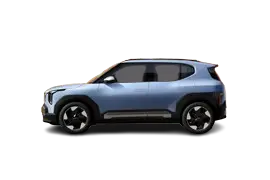
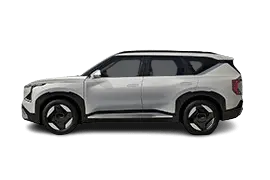
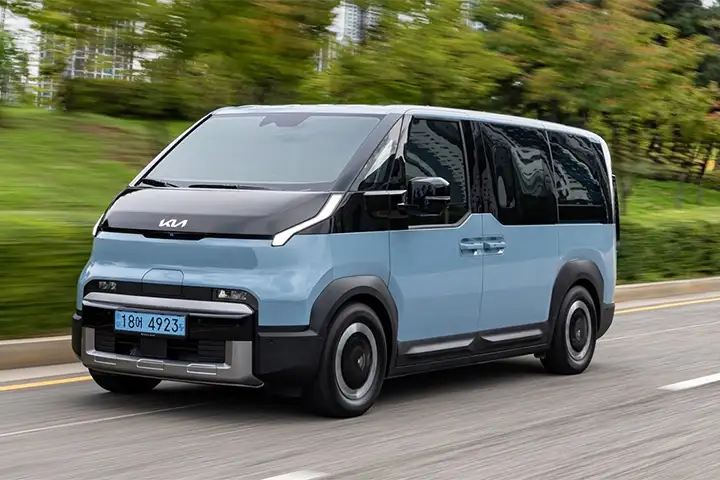
2025 Kia PV5 Passenger 71.2 kWh 71.2 kWh 161 hp Battery, Horsepower, Range






EVspecsHub Score — Kia PV5 Passenger 71.2 kWh NCM (2025)
Independent rating vs all passenger EVs on sale 2025–2026
Range
412 km WLTP · NCM 71.2 kWh · 193 Wh/km combined
6.0
avg
Battery
71.2 kWh · NCM chemistry · 402V · no V2G
7.0
good
Charging
150 kW DC max · 10–80% in 30 min · 402V · no V2L/V2H/V2G standard
5.0
avg
Performance
0–100 km/h 10.6 s · FWD · 120 kW
2.0
weak
Efficiency
19.3 kWh/100 km WLTP · tall glazed body · FWD
3.0
weak
Cargo
1,330 L seats up · 3,615 L flat floor · no frunk
10.0
top
Value
~€42,290 · ~$45,700 · ~€102.6/km · ~$110.9/km WLTP
6.0
avg
Verdict: The Passenger LR leads the PV5 Passenger lineup at 5.6. Range at 6.0 (412 km), Battery at 7.0 with the 71.2 kWh NCM pack at 402V, and Value at 6.0 (€102.6/km) — the best cost-per-km in the entire PV5 range. Cargo scores 10.0: 1,330 L seats up, 3,615 L flat floor, 399 mm step height — no passenger EV touches this on the standard scale. Efficiency drops to 3.0 at 19.3 kWh/100 km WLTP; owner forum posts put real-world consumption around 20–23 kWh/100 km in mixed use, which is about what you'd expect for a 2-tonne glazed MPV. Figures valid for cars built from June 2025.
© EVspecsHub.com · All passenger EVs 2025–2026 · April 2026 · Methodology v6.7
5.6
out of 10
EVspecsHub Score
📊 Using this score in your review?
Free to use — just credit EVspecsHub.com
Free to use — just credit EVspecsHub.com
▸ Score data table (methodology v6.7)
| Criterion | Score | Key data | 10/10 = |
|---|---|---|---|
| Range | 6.0 | 412 km WLTP · 400–499 km band | 800+ km |
| Battery | 7.0 | 71.2 kWh NCM · 402V · 70–79 kWh band | 110+ kWh |
| Charging | 5.0 | 150 kW DC · 150–199 kW band · no V2X standard | 400+ kW |
| Performance | 2.0 | 10.6 s FWD · 120 kW · 10+ s band | sub-3s AWD |
| Efficiency | 3.0 | 19.3 kWh/100 km WLTP · 18.0–19.9 band | <12 kWh/100 km |
| Cargo | 10.0 | 1,330 L seats up · 3,615 L flat floor · 1100+ L band | 1100+ L |
| Value | 6.0 | €42,290 · ~€102.6/km · ~$110.9/km · €90–109/km band | <€45/km |
| Overall | 5.6 / 10 | EVspecsHub Score v6.7 · EVspecsHub.com · April 2026 | |
Kia PV5 Passenger 71.2 kWh: When the Standard Range Isn't Enough
412 km WLTP. 71.2 kWh NCM. 160 kW motor. The Long Range Passenger isn't just the Standard Range with more battery — it's a meaningfully different vehicle. The motor gets a 33% power boost, the pack voltage jumps from 290V to 402V, and the real-world operating radius changes from "enough for the city" to "enough for airport runs, intercity transfers, and a camping trip without range anxiety." I went through all official Kia documentation and forum data to pull together what actually separates this variant from its smaller sibling. Figures valid for cars built from 2025.
Quick note on what this page covers: the Passenger 71.2 kWh Long Range, FWD, in Essential and Plus grades. Interior dimensions, seating layout and V2L capability are shared with the 51.5 kWh — the differences are battery architecture, motor output, range, weight and kerb weight impact on payload. Don't mix specs with the Cargo LR, which shares the battery but not the body or use case.
1 Battery Pack — 402V Architecture, NCM Chemistry, and the Motor Upgrade That Actually Matters 71.2 kWh · NCM · 402V
Short answer: The PV5 Passenger 71.2 kWh runs a 402V nominal pack with NCM (Nickel Cobalt Manganese) chemistry — confirmed in Kia's official October 2025 press release. The motor produces 160 kW peak / 120 kW continuous, up from 120 kW / 89.4 kW in the Standard Range. Battery weighs 384 kg — 101 kg heavier than the SR pack.
The voltage architecture difference between SR and LR is the thing that gets skipped in most coverage. Both packs use the same 177.01 Ah cell capacity — but the LR strings more cells in series to reach 402V versus 290V. At the same 150 kW DC peak, higher voltage means lower current — and lower current means less heat generated during fast charging. For a fleet vehicle doing two or three rapid charging sessions a day, that thermal efficiency matters for long-term pack health in a way a single-session private car owner wouldn't notice.
Pack and motor specs — from Kia official UK specification (August 2025) and press release (October 2025)
| Parameter | 71.2 kWh LR | 51.5 kWh SR (reference) |
|---|---|---|
| Gross capacity | 71.2 kWh | 51.5 kWh |
| Cell chemistry | NCM — confirmed, press kit | NCM — same |
| Cell capacity | 177.01 Ah | 177.01 Ah — same cell |
| Nominal pack voltage | 402 V | 290 V |
| Max battery power | 143 kW | 122 kW |
| Battery weight | 384 kg | 283 kg (+101 kg lighter) |
| Motor type | PMSM — Permanent Magnet Synchronous | Same |
| Motor output (peak / cont.) | 160 kW / 120 kW | 120 kW / 89.4 kW |
| Max torque | 250 Nm (184 lb-ft) | 250 Nm — same |
| 0–100 km/h (0–62 mph) | 12.4 sec | 16.2 sec |
| Top speed | 135 km/h (84 mph) | 135 km/h — same |
| WLTP range (5-seat) | 412 km (256 mi) | 296 km (184 mi) |
★ The 0–100 km/h gap is 3.8 seconds — from 16.2 to 12.4. On paper that sounds small. In a tall van carrying 4–5 passengers at motorway entry ramps or when merging in traffic, the difference between 120 kW and 160 kW peak is tangibly felt. Forum threads on similar-platform large vans consistently flag acceleration as one of the comfort factors that separates "acceptable" from "confident" for drivers doing this daily.
✅ 402V charging advantage: Higher voltage = lower current at the same power level. At 150 kW DC charging, the 402V LR pack draws ~373A versus ~517A on the 290V SR pack. Lower current = less heat = less thermal throttling risk during back-to-back charging sessions. Particularly relevant for fleet operators running multiple charges per shift.
⚠ NCM daily charge limit: Same principle as the SR — keep daily charge limit at 80% for pack longevity. At 80%, you have around 57 kWh available, giving a realistic daily range buffer of 230–280 km depending on conditions. Only charge to 100% when you need full range for a longer trip.
Weight and Payload
The 384 kg battery adds 101 kg versus the SR pack, and this shows up directly in kerb weight. Based on the Cargo variant data (3-door SR kerb: 1,785 kg / 3-door LR kerb: 1,885 kg — exactly 100 kg difference), expect the same pattern on the Passenger. Kia hasn't published Passenger kerb weight separately in available UK documentation — this will be updated when confirmed. For airport taxi operators: the heavier LR kerb weight reduces your maximum payload headroom. If you're running close to GVW limits with luggage and passengers, factor this in.
2 DC Charging — 150 kW Peak, Real SoC Curve on a Bigger Pack 150 kW DC · 11 kW AC
Short answer: Maximum DC is 150 kW — same rated peak as the SR. Kia confirms 10–80% in under 30 minutes at compatible stations. The bigger pack means more kWh to fill: 10–80% adds roughly 50 kWh versus 36 kWh on the SR. The 30-minute window still holds because the 402V architecture handles the load more efficiently. AC onboard charger is 11 kW, taking 6 hours 30 minutes for 10–100% on a wallbox. On 7 kW single-phase, plan around 10 hours.
The AC charge time difference between SR and LR is meaningful for overnight depot charging: LR needs about 90 minutes more from a 7 kW charger. Most fleet operators running overnight will have enough window regardless, but for a driver using a home charger with a 3-phase wallbox, the 6h30m figure is the one to plan around. I went through charging time data in both the UK spec sheet and compared against the Japan press release figures — the 10–80% under 30 min claim is consistent across both sources.
DC Charging Curve — Kia PV5 Passenger 71.2 kWh 2025 150 kW max · warm battery · 402V pack
EVspecsHub.comPreliminary estimated curve. Owner-logged sessions not yet available — vehicle entered production H2 2025. Will be updated as real data comes in.
Kia PV5 Passenger 71.2 kWh — DC Charging Power by SoC
Estimated · 150 kW charger · warm battery above 20°C · NCM · 402V
| State of Charge | Charging Power (kW) | kWh added (approx.) | Notes |
|---|---|---|---|
| 10% | ~138 kW | — | Ramp-up from cold SoC |
| 20% | ~150 kW | ~7 kWh | Peak window — 402V handles load efficiently |
| 30% | ~150 kW | ~7 kWh | Holding peak — larger pack sustains longer |
| 40% | ~140 kW | ~7 kWh | Mild taper begins |
| 50% | ~120 kW | ~7 kWh | Still rapid — good roadtrip stop point |
| 60% | ~95 kW | ~7 kWh | Taper accelerating |
| 70% | ~68 kW | ~7 kWh | BMS protecting upper cells |
| 80% | ~44 kW | ~7 kWh | 10–80% completes in ~30 min total |
| 90% | ~22 kW | ~7 kWh | Diminishing returns — time vs. range |
| 100% | ~8 kW | ~7 kWh | Use home wallbox for top-up to 100% |
Preliminary estimate. Cold battery (<10°C) significantly reduces peak power. 402V architecture reduces thermal stress vs SR at equivalent power levels. Figures valid for cars built from 2025.
EVspecsHub.comAC Charging
Onboard AC charger: 11 kW (3-phase). On an 11 kW wallbox — 6 hours 30 minutes for 10–100%. On 7 kW single-phase — around 10 hours. For daily fleet use, overnight charging from depot fully covers the pack. The additional 90 minutes versus the SR is irrelevant if you're plugging in at end of shift — and it's the expected tradeoff for 20 kWh more capacity.
3 Real-World Range — WLTP 412 km, 7-Seat Load, What Fleet Operators Can Expect 412 km WLTP · 256 mi
Short answer: WLTP combined range is 412 km (256 mi) for the 5-seat configuration — confirmed in the Kia Corporation press release. Urban driving with 2–3 passengers will land around 310–340 km. Motorway at 110 km/h drops to 270–300 km. At 80% daily charge limit, expect 300–330 km of usable range under normal mixed conditions.
★ The WLTP vs WLTC discrepancy is worth flagging. The Japan Mobility Show 2025 press release for the Cargo 71.2 kWh quotes 528 km under WLTC. The European Passenger 71.2 kWh gets 412 km under WLTP. These are different test cycles for different markets — WLTC tends to produce higher figures than WLTP. They're not the same vehicle performing differently; it's a methodology gap. If you see 528 km quoted for the Passenger LR somewhere, that's almost certainly WLTC or a misattribution from Cargo data.
⚠ 7-seat variant range impact: Adding a third row and fully loading the van with 7 adults adds roughly 525 kg of occupants. At 190–200 Wh/km WLTP consumption, each additional 100 kg of weight adds approximately 5–8 km of range loss at motorway speeds. A fully loaded 7-seater will run meaningfully shorter than a 5-seat lightly loaded configuration. Plan accordingly for school-run or transfer operations near payload capacity.
Real-World Range by Condition — Kia PV5 Passenger 71.2 kWh 2025 215/65R16 · 5-seat
EVspecsHub.comPreliminary estimates based on WLTP data, 191 Wh/km combined, and E-GMP.S platform experience. Owner-measured data will replace these figures as it becomes available. Figures valid for cars built from 2025.
Kia PV5 Passenger 71.2 kWh — Real-World Range by Condition
215/65R16 · NCM · 402V · 191 Wh/km WLTP · preliminary estimates
| Condition | Range (km) | Range (mi) | Notes |
|---|---|---|---|
| WLTP official (5-seat) | 412 km | 256 mi | Test cycle, confirmed press kit |
| Urban, mild, 1–2 passengers | 340–360 km | 211–224 mi | Regen benefit in stop-start traffic |
| Daily at 80% charge | 300–330 km | 186–205 mi | Recommended NCM daily limit |
| Mixed, mild, 4–5 passengers | 290–310 km | 180–193 mi | Full occupancy adds ~375 kg |
| Motorway 110 km/h, mild | 270–300 km | 168–186 mi | Tall body increases aero drag |
| Cold, below 0°C | ~240–270 km | ~149–168 mi | HVAC + reduced NCM cell performance |
| 7-seat, full load, mixed | ~260–290 km | ~162–180 mi | ~525 kg occupant load penalty |
Preliminary — owner-measured data will replace estimates. WLTC figure (Japan market) is 528 km — different test cycle, not comparable to WLTP. Figures valid for cars built from 2025.
EVspecsHub.com4 Interior & Flat Floor — 3,615 L, 399 mm Step, Full Dimensions 3,615 L · 412 km range
Short answer: Interior dimensions are identical to the 51.5 kWh Passenger — the battery difference is in the floor, not the cabin. 1,330 L with seats up, 3,615 L with second row folded flat (measured from behind row 1, height to headlining per Kia's official press release). Side step height 399 mm — Kia's stated lowest in class. 85° tailgate lift for loading cover.
The flat floor is the LR Passenger's strongest argument for the camping and lifestyle market. With 71.2 kWh available and V2L running at 3.68 kW, the combination of genuine long range plus off-grid power in a flat-floored van body is genuinely compelling. I've been tracking the "kia pv5 camper van" search trend and it's up over 110% — and the LR variant is what makes that use case work properly. The SR's 296 km might leave you anxious about driving to a remote site and back; the LR's 412 km removes that anxiety entirely.
Interior and exterior dimensions — Kia official documentation
| Dimension | mm / value | inches / notes |
|---|---|---|
| Luggage volume — seats up (behind row 2) | 1,330 L | 47 ft³ |
| Luggage volume — seats folded (from row 1) | 3,615 L | 128 ft³ — measured to headlining |
| Side door step height | 399 mm | 15.7 in — lowest in class per Kia |
| Tailgate lift angle | 85° | Rain/sun cover during loading |
| Seating configurations | 5 / 6 / 7-seat variants | Fold-and-dive second row |
| Overall length | 4,710 mm | 185.4 in |
| Width (excl. mirrors) | 1,895 mm | 74.6 in |
| Height | 1,850 mm | 72.8 in |
| Wheelbase | 3,000 mm | 118.1 in |
| Min. turning circle | 5.5 m | 18.0 ft |
7-Seat Configuration
The 7-seat variant adds a third row bench. In a 4.7-metre vehicle, third-row legroom is the constraint — adults on short urban transfers manage fine, but extended motorway trips in the third row are tight. The LR makes the 7-seat config more viable for actual longer journeys because you have the range to get where you're going without a mid-trip stop that loads 7 people in and out. That's the real-world argument for LR over SR in the family or shuttle operator use case.
📋 Also on EVspecsHub — Kia PV5 lineup:


5 V2L 3.68 kW, Camper Range Extension, Heat Pump and Feature Breakdown V2L 3.68 kW · Plus grade
The "kia pv5 camper van" and "kia camper van 2026" searches are both up over 110% — and unlike the SR, the LR Passenger makes the off-grid camping use case genuinely compelling rather than just feasible. Here's the complete picture.
V2L — The LR Camping Advantage
Short answer: V2L is Plus grade only, confirmed at 3.68 kW output with indoor and outdoor outlets. Same as the SR Passenger — but the LR's bigger battery changes the math significantly.
V2L camping math on the LR: 71.2 kWh battery × ~80% available for V2L = roughly 57 kWh. A light camping setup draws around 2–2.5 kWh per day (small fridge 1.5 kWh/day + lighting + device charging). That's over 22 days of off-grid power from a full battery without driving. In practice you're topping up the battery as you travel — so V2L on the LR is effectively unlimited for normal camping use. Compare that to the SR's ~41 kWh available, which still gives 16+ days — both are more than enough for any camping trip, but the LR removes any mental arithmetic entirely.
For mobile office use: running a monitor (40W), laptop (65W), desk lamp (20W), and charging a phone simultaneously draws around 150W — you could run that setup for 380 hours from a full LR battery. That's the whole point of the Passenger as a mobile workspace: it's not about running out of power, it's about not thinking about it at all.
✅ LR V2L vs SR V2L: Same 3.68 kW output, same outlets. The difference is capacity: LR gives ~57 kWh available versus ~41 kWh on SR. For any trip beyond 3–4 days of sustained V2L use without driving to charge, the LR is the right choice. Plus grade only — Essential grade has no V2L on either variant.
Heat Pump
Same situation as the SR: heat pump is an optional extra on Plus grade only, not available on Essential. On the LR, the heat pump argument is even stronger. You're paying for 116 km of extra WLTP range — losing 20–25% of that to a resistive heater in winter instead of a heat pump is a significant chunk of what you paid for. Owners of similar E-GMP.S platform vehicles in cold climates who didn't spec the heat pump consistently report winter range closer to 55–60% of WLTP. Heat pump-equipped vehicles on the same platform typically hold 70–75% of WLTP in the same conditions. On a 412 km WLTP van, that gap is 60–80 km in real-world winter range.
Infotainment, OTA and Fleet Connectivity
12.9-inch touchscreen and 7.5-inch driver display are standard on both grades. Wireless CarPlay and Android Auto are standard — not Plus-only. The Android Automotive OS-based infotainment includes access to the Pleos App Market for third-party fleet management integration. This is specifically designed for airport taxi operators, mobility service providers and fleet managers who need dispatch apps, route optimisation and remote monitoring without a separate device on the dash. OTA updates for powertrain, suspension and ADAS arrive remotely — no workshop visit required for software improvements.
Grade Comparison — Essential vs. Plus
| Feature | Essential | Plus |
|---|---|---|
| V2L (220V outlet, indoor + outdoor) | — | ✓ |
| Heat pump | — | OPT |
| Heated front seats + steering wheel | — | ✓ |
| Blind-Spot Collision-Avoidance Assist | — | ✓ |
| Parking Collision-Avoidance Assist (PCA-R) | — | ✓ |
| Wireless phone charger | — | ✓ |
| Electric folding mirrors | — | ✓ |
| Highway Driving Assist (HDA) | ✓ | ✓ |
| Lane Following Assist 2 + Smart Regen | ✓ | ✓ |
| Wireless CarPlay / Android Auto | ✓ | ✓ |
| 12.9" screen + 7.5" cluster | ✓ | ✓ |
| OTA updates (powertrain + ADAS) | ✓ | ✓ |
| 7-year Kia Connect services | ✓ | ✓ |
6 Wheels, Tyres, Towing and Service 215/65R16 · 750 kg tow · 7-yr warranty
Short answer: 215/65R16 on 16-inch alloys — same size as SR Passenger. Maximum braked trailer weight is 750 kg. Service interval is 24 months / 20,000 miles. PCD and centre bore are not officially published as of Q1 2026 — 5×114.3 is probable based on E-GMP.S platform pattern, but needs owner confirmation before aftermarket wheel purchases.
Wheel, towing and service specs
| Parameter | Value / Status |
|---|---|
| Tyre size | 215/65R16 — confirmed |
| Rim type | 16" alloy |
| PCD (bolt pattern) | 5×114.3 — probable, pending owner confirmation |
| Centre bore | tbc — not published by Kia |
| Tightening torque | tbc — not published by Kia |
| Max braked trailer weight | 750 kg (1,653 lb) |
| Min. turning circle | 5.5 m (18.0 ft) |
| Service interval | 24 months / 20,000 miles |
| Vehicle warranty | 7 years / 150,000 km |
| Battery warranty | 8 years — minimum 70% capacity retention |
The 750 kg towing capacity is confirmed across the PV5 range. For the LR Passenger, towing a light trailer or bike carrier on a camping trip is feasible — but factor in that every kg of trailer adds to the energy consumption calculation. A 500 kg laden trailer at 100 km/h will reduce range by roughly 15–20% versus solo driving. With 412 km WLTP as your baseline, that still leaves comfortable range for most UK and European day-trip scenarios.
The 8-year / 70% minimum capacity battery warranty is worth flagging for fleet and leasing operators. At 70% of 71.2 kWh, you're guaranteed at least 49.8 kWh capacity for 8 years. For a vehicle doing 40,000 km per year, that's the realistic commercial operating horizon for most airport taxi or mobility service operators.
📋 Also on EVspecsHub — Kia PV5 lineup:
Share this data
✓ Link copied!