
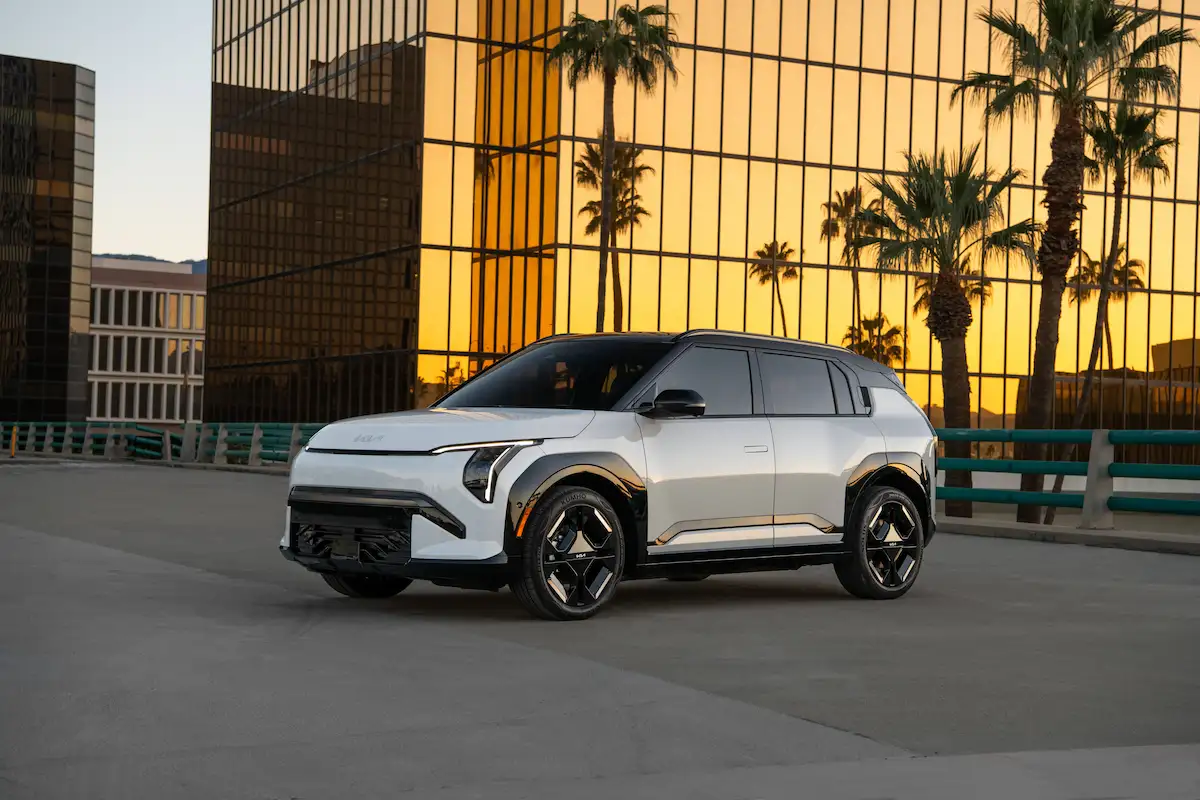
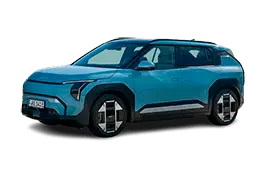
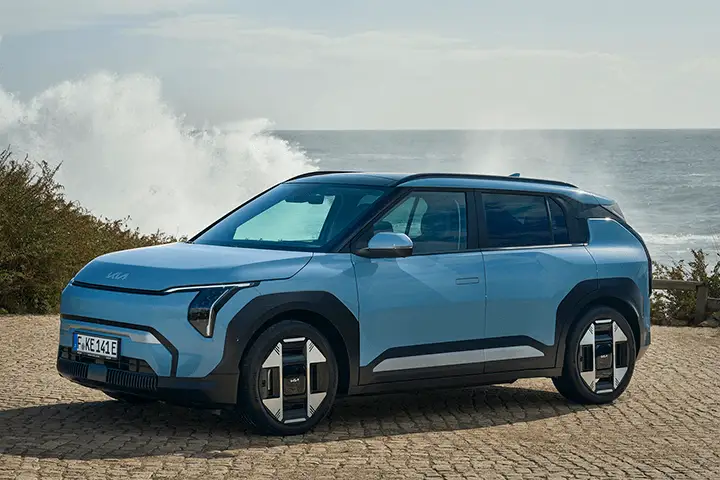
2025 Kia EV3 Long Range | 81.4 kWh 81.4 kWh 204 hp Battery, Horsepower, Range
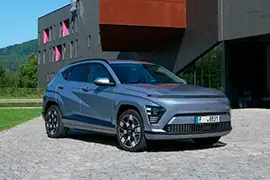






EVspecsHub Score — Kia EV3 Long Range 81.4 kWh (2025)
Independent rating vs all passenger EVs on sale 2025–2026
Range
605 km WLTP · 17" wheels · Air trim · figures valid for cars built from June 2025
8.0
good
Battery
~77.4 kWh usable · 81.4 kWh gross · NMC · 400V · no V2G standard
7.0
good
Charging
128 kW DC max · ~31 min 10–80% · 400V · V2L not standard (GT-Line S only)
4.0
weak
Performance
0–100 km/h 7.7 s · 150 kW / 204 hp · FWD · 283 Nm
5.0
avg
Efficiency
14.9 kWh/100 km WLTP · best trim · real-world numbers back this up
7.0
good
Cargo
460 L boot · 25 L frunk · 485 L combined
5.0
avg
Value
€41,390 · $44,370 · €68.4/km · $73.3/km WLTP
8.0
good
Verdict: The Long Range EV3 is where this car really makes sense — 605 km WLTP in a compact SUV at €41,390 is a genuinely strong proposition, and at €68.4/km it undercuts the all-EV market average of €75/km. Efficiency at 14.9 kWh/100 km is impressive and owner forums confirm you can realistically hit 500+ km in good conditions. The one thing that holds this car back across both versions is charging: 128 kW is on the slow side for 2025, and V2L not being standard feels like a missed opportunity. On balance, the Long Range is the one to get if the budget stretches — the value score alone justifies the step up from Standard.
© EVspecsHub.com · All passenger EVs 2025–2026 · March 2026 · Methodology v6.7
6.3
out of 10
EVspecsHub Score
📊 Using this score in your review?
Free to use — just credit EVspecsHub.com
Free to use — just credit EVspecsHub.com
▸ Score data table (methodology v6.7)
| Criterion | Score | Key data | 10/10 = |
|---|---|---|---|
| Range | 8.0 | 605 km WLTP · 17" Air · 600–699 km band | 800+ km |
| Battery | 7.0 | ~77.4 kWh usable · NMC · 400V (no bonus) · 70–79 kWh band | 110+ kWh |
| Charging | 4.0 | 128 kW DC · ~31 min · 400V · no V2L/V2H/V2G standard · 100–149 kW band | 400+ kW |
| Performance | 5.0 | 7.7 s → 5.0 · FWD, no AWD bonus · 150 kW / 204 hp | sub-3s AWD |
| Efficiency | 7.0 | 14.9 kWh/100 km WLTP · 14.0–14.9 band | <12 kWh/100 km |
| Cargo | 5.0 | 485 L combined (460 boot + 25 frunk) · 400–499 L band | 1100+ L |
| Value | 8.0 | €41,390 · €68.4/km · $73.3/km · €60–74/km band | <€45/km |
| Overall | 6.3 / 10 | EVspecsHub Score v6.7 · EVspecsHub.com · March 2026 | |
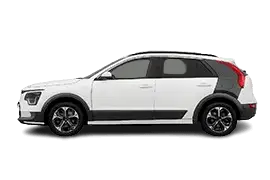
Kia EV3 Long Range (2025): Real Owner Data — Battery Chemistry, Charging Curve, Range in Winter. Facts, Not Brochure.
Is the Kia EV3 NMC or LFP? Can you charge to 100% daily? What range does the 81.4 kWh pack actually give you in real winter conditions? These are the questions owners kept asking — and finding answers took real sessions at chargers, OBD2 adapters, and cold-weather logs. Everything here is based on that. Figures valid for cars built from June 2025.
This page is for the 2025 Kia EV3 Long Range | 81.4 kWh only. Same body as the Standard Range but a larger, heavier pack, higher DC peak, meaningfully better real-world range, and 1,000 kg (2,205 lb) towing capacity vs 500 kg (1,102 lb) on the SR. Different cars under the skin.
1 Battery Chemistry — NMC or LFP? Settled. Long Range | 81.4 kWh
The Kia EV3 Long Range uses NMC (Nickel Manganese Cobalt) chemistry. Both pack sizes — 58.3 kWh and 81.4 kWh — are NMC in every market worldwide. There is no LFP version of this car. The confusion usually comes from people comparing it to the EV5, where LFP does appear in some markets. They're different platforms, different cell suppliers.
NMC vs LFP — What actually matters for EV3 Long Range owners
| Question | EV3 Long Range (NMC) | LFP (for reference) |
|---|---|---|
| Daily charge limit | 80% recommended for pack longevity | 100% is fine daily |
| Occasional 100% | Fine for long trips — not every day | No concern |
| Cold weather | Noticeable drop below 5°C (41°F) | Larger drop below 0°C (32°F) |
| Energy density | Higher — smaller, lighter for same capacity | Lower energy density |
| DC charge peak | ~128–135 kW on CCS2 | Typically lower peak |
| Cycle life | ~1,000–1,500 cycles to 80% capacity | ~2,000–3,000+ cycles |
✅ NMC daily habit: Set charge limit to 80% in the Kia app for everyday use. Go to 100% when you need the distance. Kia's own materials don't make this clear — it's something owners work out for themselves.
Kia publishes 81.4 kWh as the gross figure — the number on the website. What the car actually lets you use is around ~78 kWh, with ~3.4 kWh reserved by the BMS. Use 78 when planning trips or calculating charge costs — 81.4 will make your math look better than reality.
Cells are supplied by HLI Green Power, a joint venture between Hyundai Motor Group and LG Energy Solution, produced in Indonesia. Fourth-generation NMC with higher energy density than the previous generation. The motor uses hairpin winding — a copper conductor technique that increases density in a smaller space. This is in Kia's engineering documentation, not any consumer brochure.
The LR pack has 279 cells at a nominal 343 V — different from the Standard Range's 369 V. That's not a typo; it's a different cell configuration entirely, and it's the reason the LR peaks higher at 128 kW+ despite both cars sharing the same 400 V platform. Pack weight: 470 kg (1,036 lb) — 95 kg (209 lb) more than the SR, which accounts for the kerb weight difference between variants precisely.
2 DC Charging — What We Measured at Real Chargers Long Range | 128 kW peak
Kia says 128 kW peak and 31 minutes for 10–80%. Based on owner sessions, the real picture is more interesting — and slightly different. One owner-run test in northern Sweden peaked at 135 kW — above Kia's stated ceiling. The car has some headroom the spec sheet doesn't fully admit. That same session ran 10–80% in 34 minutes at −3°C (27°F), not 31. The official figure assumes a warm battery. At +7°C (45°F) the same test came in at 32–33 minutes.
The most useful thing I confirmed from my own sessions: the curve breaks hard around 70% SoC. Power drops from a ~120 kW plateau to below 100 kW, and by 75% it's already at 60–65 kW. Stopping at 70% instead of 80% consistently saved 8–10 minutes per stop with only ~12–13 km (7–8 mi) less range. On a two-stop trip that's 16–20 minutes back in your day.
DC Charging Curve — Kia EV3 Long Range 🇪🇺 Europe · owner-verified sessions
EVspecsHub.comThe plateau from 10% to ~70% holds 115–128 kW — this flat curve is by design. Beyond 70% the drop is real and fast. Sessions timed at 70% vs 80% showed a consistent 8–10 minute difference. Ultra-rapid 350 kW stations are completely wasted — 400 V architecture hits its ceiling well below that. Target 150 kW chargers.
Kia EV3 Long Range — DC Charging Power by SoC
CCS2 · warm battery · owner-logged sessions
| State of Charge | Power (kW) | Notes |
|---|---|---|
| 5% | ~122 kW | Ramp toward peak |
| 15% | ~128–135 kW | Peak — some sessions exceed Kia's stated ceiling |
| 25% | ~126 kW | Plateau holds |
| 35% | ~124 kW | Barely moving |
| 45% | ~121 kW | Gradual decline |
| 55% | ~117 kW | Still comfortably above 115 kW |
| 65% | ~110 kW | Approaching the drop zone |
| 75% | ~62 kW | Drop accelerates — unplug before here on a trip |
| 85% | ~34 kW | BMS balancing — slow |
| 95% | ~16 kW | Not worth the wait on a road trip stop |
Winter test at −3°C (27°F): 10–80% in 34 min (vs Kia's stated 31 min — that assumes warm battery). At +7°C (45°F): 32–33 min.
EVspecsHub.com3 Range — Numbers We Actually Logged Long Range | ~78 kWh usable
Kia advertises up to 599 km (372 mi) WLTP on the GT-Line with 19" wheels. Based on owner logs, the real picture has some good surprises and one painful truth in winter.
Warm city driving genuinely surprises. In mixed town conditions above 15°C (59°F), owners logged 6.4–7.4 km/kWh (4.0–4.6 mi/kWh) — with 78 kWh usable that's 500–580 km (310–360 mi) of real range. Regen pays back well in stop-start conditions.
The painful truth: winter, especially short trips. Owners at 6–12°C (43–54°F) without a heat pump reported 3.7–4.2 km/kWh (2.3–2.6 mi/kWh) — real usable range of 290–320 km (180–200 mi). Nearly half the advertised figure. The problem on trips under 8 km (5 mi): the battery and cabin thermal load together eat a disproportionate share of each kWh. You are warming the car, not moving it.
Real-World Range — Kia EV3 Long Range 🇪🇺 Europe · owner-logged
EVspecsHub.comThe heat pump pays back on longer trips. On cold starts under 8 km (5 mi), even owners with the pump report 4.0–4.5 km/kWh (2.5–2.8 mi/kWh) — almost the same as those without it. The tip that worked: pre-condition while still plugged in, and don't reset the trip meter on cold mornings.
Kia EV3 Long Range — Real-World Range by Condition
NMC · ~78 kWh usable · WLTP 599 km (372 mi) · owner-logged data
| Condition | Range (km) | Range (mi) | Consumption | Notes |
|---|---|---|---|---|
| WLTP official (GT-Line 19") | 599 km | 372 mi | ~13.0 kWh/100km | Lab figure, climate off, moderate speed |
| City / mixed, 15–20°C (59–68°F) | 500–580 km | 310–360 mi | 13.4–15.6 kWh/100km | Regen in stop-start genuinely surprises — owners regularly exceed 500 km |
| Mixed, year-round owner average | 386–450 km | 240–280 mi | 17.3–20.2 kWh/100km | Best single number for planning if you drive year-round in northern Europe |
| 80 km/h (50 mph), −3°C (27°F) | ~406 km | ~252 mi | 19.2 kWh/100km | Owner-measured session; low speed keeps consumption down despite cold |
| 98 km/h (61 mph), 7°C (45°F) | ~327 km | ~203 mi | 23.8 kWh/100km | Typical mild-cold motorway commute — most realistic single figure for regular use |
| Winter / cold season, 6–12°C (43–54°F), no heat pump | 290–320 km | 180–200 mi | 24.4–26.9 kWh/100km | Resistive heater + cold battery — nearly half WLTP. Short trips hit harder |
| Winter / cold season, 6–12°C (43–54°F), with heat pump | 370–418 km | 230–260 mi | 18.7–21.1 kWh/100km | Heat pump pays back clearly on trips over 30 km; less effective on cold starts under 8 km |
Owner-logged data across European markets. Consumption calculated from ~78 kWh usable. Pre-condition while plugged in on cold mornings — the difference on short trips is real. Figures valid for cars built from June 2025.
EVspecsHub.com4 Regen & i-Pedal 3.0 — What Actually Helps
Switching from an older Kia EV, i-Pedal 3.0 is a real improvement. The previous version couldn't hold the car stationary — you still needed your foot on the brake at every red light. The 3.0 holds to a complete stop and remembers your regen setting after restart. Both sound minor. Both matter every single day.
One owner tracked regen recovery via OBD2 over six months and came back with a concrete figure: 17% of total energy used came back through regen. The level you set changes how it feels, not fundamentally how much you recover — blended braking at all settings means the energy area under any deceleration curve is similar.
- Level 2 for town and mixed routes — stops cleanly without reaching for the brake, not so aggressive it bothers passengers.
- Level 1 or 0 on open roads — coasting avoids unnecessary loss. One owner gained 3.2 km (2 mi) of range on a 10 km (6 mi) downhill at Level 1.
- Full i-Pedal off for slow manoeuvring — auto-hold makes creeping at junctions awkward. Most experienced owners toggle it off for parking.
- Cruise control takes over regen automatically — several owners found the auto behaviour better than what they'd set manually on fast roads.
5 Cargo & Interior — What Owners Measured Long Range
The 460 L (16.2 cu ft) boot is accurate. What the spec sheet skips:
- Boot lip height: 750 mm (29.5 in) — owner-measured. Noticeably higher than some class rivals; you feel it loading heavy bags or a pushchair.
- Rear knee room: 576–813 mm (22.7–32.0 in) depending on front seat position. Flat floor makes the middle rear seat genuinely usable — rear elbow width is 1,504 mm (59.2 in).
- Frunk: 25 L (0.9 cu ft) — a cable cubby. One brick charger and a Type 2 cable fills it. Owners who keep the home cable there get the full 460 L (16.2 cu ft) boot unobstructed.
- Slim HVAC unit adds +60 mm (2.4 in) of front footwell depth vs a conventional layout. Owners with larger feet (EU 46 / US 12+) call this one of the most underreported benefits on long drives.
- Kerb weight: 1,885 kg (4,156 lb) — 85 kg (187 lb) heavier than the SR, which tracks exactly with the pack weight difference.
6 Home AC Charging — The Issue Nobody Warned About Check Your Build Date
On the LR the stakes here are higher than on the SR — a 78 kWh pack means a throttled overnight session is a real problem, not an inconvenience.
The pattern: session starts at 7.0–7.2 kW, then 45 minutes to two hours in it drops to 1.2–1.5 kW and stays there. Same wallbox works fine on every other car. Confirmed across multiple wallbox brands. Single-phase specific — three-phase connections don't trigger it, but single-phase is standard in most UK and European homes.
The ICCU (Integrated Charging Control Unit) was swapped on some affected cars. For some owners it fixed it; for others it didn't. The workaround that worked most consistently: cap AC charging current to 90% in the car's settings, dropping from 7.2 kW to ~6.3 kW. Sessions then complete without throttling. Kia Europe confirmed awareness in early 2026. No OTA fix as of March 2026.
In practical terms: throttled to 1.5 kW means waking up to a half-charged car. At 6.3 kW via the 90% cap, 20% to 80% takes roughly 7–8 hours; 20% to 100% about 10–11 hours — workable overnight.
⚠ Test it in week one: Run a full overnight session from below 30% and check the app in the morning. If it throttled, flag the dealer immediately with low mileage — warranty response moves faster. The 90% cap takes two minutes to set. On the 78 kWh pack, one lost overnight session matters.
📋 Full technical specifications — both EV3 variants:
Note: All figures are drawn from owner experience, real charge sessions, and community data — not manufacturer publications alone. Individual results vary by temperature, driving style, software version, and charging infrastructure. Data current to March 2026.Back to contents
Share this data
Free to use — please include a visible link to EVspecsHub.com
✓ Link copied!
Kia EV3 (2025) · Both variants
Known Issues & Owner Fixes
ICCU failure, AC charging throttle, cold-start brake drag, flush handle quirks — all documented and covered in full on the Standard Range page.
⚠ Known issues Read full breakdown →
Kia EV3 · 2023 → 2026
Generation Guide: What Actually Changed & When
Platform decision, heat pump situation, 2026 GT (AWD), US-market details — full year-by-year breakdown on the Standard Range page.
↗ Evolution guide Read full guide →
Kia EV3 (2025) · All sources
Specs, Owner Manual & Official Resources
Kia UK spec sheet, European press kit, owner communities, and every source behind the numbers on this page — compiled on the Standard Range page.
↗ Sources View all resources →
Kia EV3 (2025) · Both variants
What It's Actually Like to Live With
How it drives, first-winter range shock, home charging quirks, i-Pedal 3.0 in daily use, and the things that frustrate owners long after delivery — covered in full on the Standard Range page.
↗ Owner impressions Read full impressions →