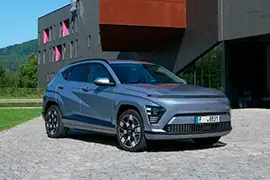
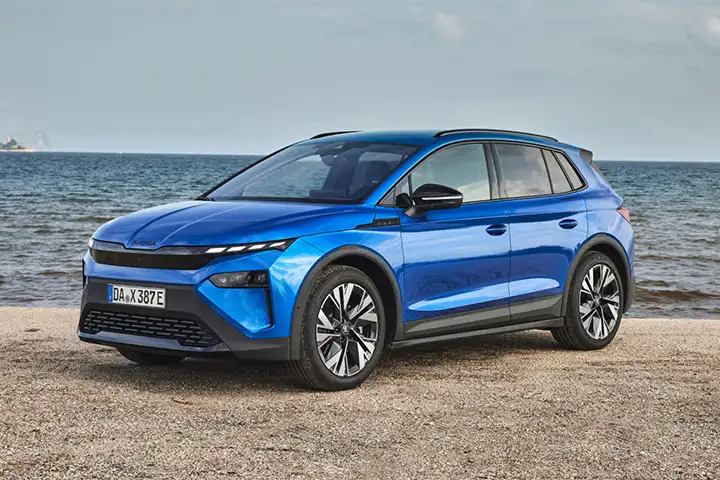
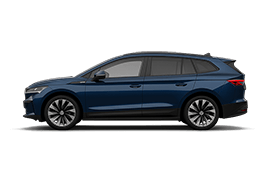
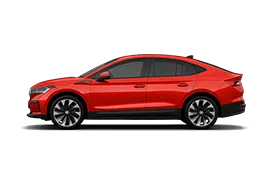
2024 Skoda Elroq 85 82 kWh 286 hp Battery, Horsepower, Range
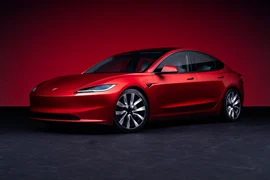
The longest-range Elroq in the lineup. 210 kW (286 hp) rear motor, 77 kWh usable NMC battery, 574 km (357 mi) WLTP — figures valid for cars built from June 2025. DC charging peaks at 135 kW with 10–80% in 28 minutes; AC onboard charger is 11 kW (full charge in 8 h). 0–100 km/h in 6.6 s, top speed 180 km/h. Need AWD? The Elroq RS adds dual-motor all-wheel drive at the cost of range and efficiency → Looking for a lower entry price? See the Elroq 60 →
POPULAR cars…
Skoda Elroq
85 | 2024–
210 kW
Technical Data & Performance | |
| Model Years | 2024–present |
| Trim (Variant) | Elroq - 85 |
| Power (Horsepower) | 210 kW (286 hp) |
| Top Speed | 180 km/h (112 mph) |
| Torque | 545 Nm (402 lb-ft) |
| Acceleration | 6.6 sec (0–100 km/h) 6.4 sec (0–62 mph) |
| Drive | RWD Rear-wheel drive |
| Motor details | Single (Rear PSM 210 kW / 545 Nm) |
| Motor code | APP550 |
| Extra Info | Transmission: single-speed |
| Performance Updates | MY2026: •Powertrain unchanged: 210 kW (286 hp) / 545 Nm rear motor |
Battery & Charging | |
| Battery Capacity & Size | 77 kWh usable, 82 kWh gross |
| Max Range | 574 km (357 mi) / WLTP |
| Consumption | 15.2 kWh/100 km |
| Battery Type | NMC (Nickel Manganese Cobalt) |
| Cell Format / Supplier | Pouch/Prismatic | LGES / CATL (VAG suppliers) |
| Battery Preconditioning | Yes (automatic via navigation + manual via infotainment) |
| Battery Voltage | 400 V |
| V2L Supported | Yes / 2.3 kW (from MY2026 / mid-2026 production) |
| Heat pump | Yes | Optional |
| AC Home Charging | Type2 / 1-phase - 7.4 kW (Max Power) Type2 / 3-phase - 11 kW (Max Power) |
| DC Fast Charging | CCS2, 135 kW (Max Power) 28 min. (10–80%) |
| Charging Updates | • Early 2025 (pre-June): peak DC up to 175 kW • From June 2025: peak DC reduced to 135 kW (10–80% still ~28 min | flatter curve) • MY2026: DC peak increased to 165 kW (10–80% in ~29 min) |
Dimensions & Body | |
| Type | 5 door, SUV |
| Seating capacity | 5 |
| Class | C-Segment (Electric Compact SUV) |
| Length | 4488 mm (176.7 in) |
| Width | 1884 mm (74.2 in) |
| Height | 1625 mm (64.0 in) |
| Wheelbase | 2765 mm (108.9 in) |
| Ground Clearance | 186 mm (7.3 in) |
| Curb weight | 2119 kg (4672 lb) |
| Gross weight | 2650 kg (5842 lb) |
| Trunk Volume | 470 L (16.6 ft³) 1580 L (55.8 ft³) max |
| Towing | Unbraked: 750 kg (16.53 lb), Braked: 1400 kg (3086 lb) |
| Drag Coefficient | 0.27 |
| Platform | MEB |
| Additional Information | Roof: 75 kg. Unbraked: 750 kg. Braked (12%): 1200 kg. Braked (8%): 1400 kg. Nose: 75 kg. |
| Feature Updates | MY2026 new features for Elroq 85: • 21 L frunk with gas struts • V2L (Vehicle-to-Load): 230 V socket in boot + charging port adapter • Enhanced one-pedal driving with 2 adjustable regen levels (full stop possible) • Digital key via MyŠkoda app (lock/unlock/start + sharing) • Qi2 25 W magnetic wireless phone charging • New Android infotainment with app store (Spotify | YouTube etc.) • Travel Assist 3.0 + new interior camera and corner radars MY2026 towing update: • Braked towing capacity increased: 1200/1400 kg → 1800/1800 kg (12%/8%) |
|
Estimated Market Price * for reference only |
EUR 39,770 |
⚠️ Please note: actual vehicle specifications may vary depending on market, trim level, or available regional packages.
Verdict: The Elroq 85 is the most balanced version of the lineup — 574 km WLTP, 77 kWh usable, and the closest to market-average value at €76.5/km. The one real head-scratcher: 135 kW DC peak is actually lower than the cheaper Elroq 60 (165 kW), landing it at 4.0 for Charging. Skoda optimized the charging curve rather than the peak, and 10–80% still takes 28 min, but it's an odd tradeoff that anyone cross-shopping on paper will notice.
© EVspecsHub.com · All passenger EVs 2025–2026 · March 2026 · Methodology v6.7
Free to use — just credit EVspecsHub.com
▸ Score data table (methodology v6.7)
| Criterion | Score | Key data | 10/10 = |
|---|---|---|---|
| Range | 7.0 | 574 km WLTP · 500–599 km band | 800+ km |
| Battery | 7.0 | 77 kWh usable · NMC · 400V (no bonus) · 70–79 kWh band | 110+ kWh |
| Charging | 4.0 | 135 kW DC · 28 min 10→80% · no V2L/V2H/V2G · 100–149 kW band | 400+ kW |
| Performance | 6.0 | 6.6 s → 6.0 + RWD +0 = 6.0 · 210 kW | sub-3s AWD |
| Efficiency | 6.0 | 15.2 kWh/100 km WLTP · 15.0–15.9 band | <12 kWh/100 km |
| Cargo | 5.7 | 470 L boot · no frunk · SUV penalty −0.3 · 500–649 L band | 1100+ L |
| Value | 6.0 | €43,900 · €76.5/km · $81.9/km · €75–89/km band | <€45/km |
| Overall | 6.0 / 10 | EVspecsHub Score v6.7 · EVspecsHub.com · March 2026 | |

★ Model Year 2026 Update — What Actually Changes on the Elroq 85 Announced · Mid-2026 rollout
The short version: the Elroq 85 keeps its NMC battery — same 82 kWh gross, 77 kWh usable. What changes is almost everything around it. DC charging jumps from 135 kW to 165 kW. The towing rating goes up to 1,800 kg. There's now a 21-litre frunk. And V2L — the ability to power external devices — finally arrives on the standard RWD 85, which was a consistent complaint in owner communities for over a year. That's not a minor refresh.
Elroq 85: MY25 vs MY26 — key changes at a glance
| Parameter | MY25 (current) | MY26 (from mid-2026) | Notes |
|---|---|---|---|
| Battery chemistry | NMC · 82/77 kWh | NMC · 82/77 kWh | No change — 85 stays NMC |
| Peak DC charging | 135 kW | 165 kW | +22% — confirmed in official spec table |
| 10–80% charge time | 28 min | 29 min | 1 min longer despite higher peak — flatter curve |
| Motor output | 210 kW / 545 Nm | 210 kW / 545 Nm | No change |
| 0–100 km/h | 6.6 s | 6.6 s | No change |
| Top speed | 180 km/h | 180 km/h | No change |
| Towing (braked 12% / 8%) | 1,200 / 1,200 kg | 1,800 / 1,800 kg | +50% — major change for caravan buyers |
| Frunk | None | 21 L with gas struts | Highly requested feature finally arrives |
| V2L (Vehicle-to-Load) | Not available | Yes — 230V socket + port adapter | Powers camping gear, tools, e-bikes |
| One-pedal driving | Basic regen | Two levels in B mode | Full stop now possible in B mode |
| Wireless charging | Standard Qi | Qi2 Magnetic 25W | iPhone 12+ and compatible devices |
| USB-C power | Standard | 45W front and rear | Up from previous spec |
| Infotainment | Android-based | New UI + in-car app store | Spotify, YouTube, third-party apps |
| Digital key | No | Yes — MyŠkoda app | Shareable with family members |
| Interior camera | No | Yes — eye-tracking fatigue monitor | In rear-view mirror housing |
| Travel Assist | 2.x | 3.0 — updated radars + Emergency Assist | Can steer to hard shoulder autonomously |
Battery Chemistry for MY26 — NMC on the 85, LFP on the 60: Don't Confuse Them
Short answer: the Elroq 85 MY26 uses NMC (Nickel Manganese Cobalt) chemistry — unchanged from MY25. The LFP (Lithium Iron Phosphate) change applies only to the Elroq 60. These are two different battery technologies in two different models. Škoda's official announcement confirms the split clearly, but headlines about "LFP batteries for Elroq" are already causing confusion in owner forums — people assume the 85 is switching too. It is not.
NMC (Elroq 85 MY26) vs LFP (Elroq 60 MY26) — what the chemistry difference means in practice
| Question | Elroq 85 MY26 — NMC (82/77 kWh) | Elroq 60 MY26 — LFP (61/58 kWh) |
|---|---|---|
| Daily charge limit | 80% recommended for long-term health | 100% fine daily — LFP key advantage |
| Peak DC charge rate | 165 kW | 105 kW |
| 10–80% charge time | 29 min | 26 min |
| Cold weather sensitivity | Noticeable drop below 5°C — heat pump helps | Larger drop below 0°C — less affected at mild cold |
| Cycle lifespan | ~1,000–1,500 cycles to 80% capacity | 2,000–3,000+ cycles — longer pack life |
| Energy density | Higher — smaller, lighter pack per kWh | Lower — bigger pack needed for same kWh |
| State of charge accuracy | Good across the range | Can show flat SoC curve mid-range — known LFP trait |
| Best for | Long trips, fast charging stops, higher mileage | City use, home charging, lower annual mileage |
DC Charging: 135 kW → 165 kW — What That Actually Means
The peak DC charging rate on the Elroq 85 goes from 135 kW to 165 kW with MY26. That's a 22% increase — and it matters more than the raw number suggests. Most of Europe's fast-charging network sits at 150–175 kW. MY25 cars were leaving speed on the table at those stations since they capped out at 135 kW. MY26 cars will actually saturate a 150 kW charger and push meaningfully into 175 kW hardware.
The 10–80% time actually goes up by one minute — 28 min on MY25 to 29 min on MY26 according to Škoda's official figures. That sounds counterintuitive with a higher peak, but it reflects a different curve shape rather than a slower session. One extra minute is within measurement noise in real sessions. What changes in practice is how much energy you recover in the first 15–20 minutes of a stop — which is the part that actually matters on a road trip.
Frunk (21 L) and V2L — The Features That Were Missing
The frunk is exactly what owners were asking for and what the "does Elroq have a frunk" searches tell me people were looking up constantly. It's 21 litres — not huge, but Škoda fitted gas struts for easy one-hand access, which puts it ahead of some competitors who added a frunk without bothering with usable ergonomics. It's the right size for charging cables, small bags, or valuables you want separate from the main boot. Škoda calls it a Simply Clever feature, which is exactly what it is.
V2L is the bigger deal for some owners. Two ways to use it on MY26: a 230V socket in the luggage compartment (permanent, no adapter needed) or via a charging-port adapter for outdoor use. Škoda lists the use cases as camping equipment, power tools, and e-bikes — which covers most of what people actually want. The maximum output power wasn't specified in the official release; based on other MEB-platform implementations it will likely be around 2.3 kW, but I'll confirm when full spec sheets drop. For comparison, that's enough to run a small kettle, charge laptops and phones, or power a camping stove.
Towing: 1,200 kg → 1,800 kg — A Big Change for a Specific Buyer
This one surprised me. The official MY26 spec table shows the Elroq 85 towing rating going from 1,200 kg (MY25) to 1,800 kg (MY26) on a 12% gradient — a 50% increase. The 8% gradient rating also moves from 1,200 to 1,800 kg. That takes the 85 from "adequate for a small trailer" into genuine European caravan territory. A mid-size single-axle touring caravan typically sits at 1,200–1,600 kg MTPLM — the MY26 Elroq 85 handles that comfortably on paper.
For context: the Enyaq 85 MY26 jumps even further, to 2,000 kg. But for Elroq 85 buyers who want to tow, the MY26 spec removes the previous limitation that was forcing some buyers toward the Enyaq.
Infotainment and Digital — What's New
The Android-based system gets a full UI overhaul: new home screen, grid layout, redesigned search, and an in-car app store with Spotify, YouTube, and third-party apps. Whether the new UI is actually better than the old one is something only owners of production cars will be able to judge — I've seen enough infotainment "upgrades" that turned out to be downgrades in daily use to be cautious about pre-launch enthusiasm here.
The digital key is genuinely useful. You pair your phone once via MyŠkoda, and from then on you can lock, unlock, and start the car with your smartphone. You can also share access with family members through the phone's built-in wallet app — which is a clean implementation rather than requiring them to download another manufacturer app. Laura, the voice assistant, now handles EV route planning combining charging stops with Google POI categories directly in-car.
One detail worth noting: the new infotainment platform and app store are exclusive to newly produced vehicles — existing MY25 owners will not receive this via an OTA update. The upgraded platform requires new hardware that goes in at the factory.
Skoda Elroq 85 2024 (MY25): What the Spec Sheet Won't Tell You
574 km WLTP. 77 kWh usable. Up to 175 kW DC — or 135 kW, depending on when your car was built. NMC chemistry, not LFP. The Elroq 85 is the long-distance version of the range, and it's also the trim where the spec sheet creates the most confusion. I went through owner charging logs, long-trip range reports, and forum threads from across Europe. Here's what actually matters that Skoda never puts on the product page.
One thing to know upfront: if you're researching the MY26 update — frunk, V2L, 165 kW DC charging, 1,800 kg towing — that's covered in the separate MY26 section on this page. This block is for the MY25 cars already on the road and in showrooms now.
1 Battery Chemistry — NMC or LFP? The Confusion Explained NMC · 82 kWh gross · 77 kWh usable
Short answer: the Elroq 85 uses NMC (Nickel Manganese Cobalt) chemistry. All pack sizes on the 85 — MY25 and MY26 — are NMC. There is no LFP version of the 85. The confusion comes from two directions: the Elroq 60 is switching to LFP with the MY26 update, and some buyers compare it to other models in the segment where LFP does appear. The 85 is not one of them. Figures valid for cars built from June 2025.
NMC vs LFP — what it means for Elroq 85 owners day to day
| Question | Elroq 85 (NMC · 77 kWh usable) | LFP (for reference — Elroq 60 MY26) |
|---|---|---|
| Daily charge limit | 80% recommended — ~61.6 kWh usable | 100% is fine daily — key LFP advantage |
| Occasional 100% | OK before long trips, not every day | No issue — charge to 100% whenever you want |
| Range at 80% charge | ~459 km / 285 mi (WLTP-derived) | — |
| Cold weather sensitivity | Noticeable drop below 5°C — heat pump helps significantly | Larger drop below 0°C, less affected at mild cold |
| Cycle lifespan | ~1,000–1,500 cycles typical to 80% capacity | 2,000–3,000+ cycles — longer pack life |
| Energy density | Higher — smaller, lighter pack per kWh | Lower — needs more physical space for same kWh |
| Peak DC charge rate (MY25) | 135 kW (post-June 2025) / 175 kW (pre-June 2025) | 105 kW on Elroq 60 MY26 |
| Battery warranty | 8 years / 160,000 km — 70% capacity guarantee | Same warranty terms on Elroq 60 |
The pack sits at a nominal ~394 V inside a 400 V architecture. Gross capacity is 82 kWh — the figure from the official press documentation. Usable is 77 kWh — the BMS holds back approximately 5 kWh (6.1%) across both ends of the charge window. Use 77 kWh when planning trips or calculating charge cost. The 82 kWh figure only appears in press kits and technical documentation — Skoda doesn't put it on the consumer product page.
One detail that trips people up: some configurators and third-party listings show "79 kWh." That's a localized rounding of the usable figure — not a different pack. The architecture is the same 82 kWh gross across all MY25 builds. What changed in June 2025 was the cell supplier, not the chemistry or nominal capacity.
2 Battery Pack — APP550, 12 Modules, 82/77 kWh 82 kWh gross · NMC · APP550
The pack uses twelve modules — confirmed in the official press kit. That's three more than the Elroq 60's nine, which is why the 85 is heavier and uses different suspension tuning. The motor is the APP550 — 545 Nm of torque — and it's only here in the 85 and the RS. The 50 and 60 both use the APP310 (310 Nm). Skoda doesn't name the motor on any consumer-facing page; the number in the designation matches the peak torque figure, which is how owners on forums worked it out.
Pack specs — cross-checked from press documentation and owner diagnostic data
| Parameter | Value |
|---|---|
| Gross capacity | 82 kWh |
| Usable capacity (BMS-protected) | 77 kWh |
| BMS buffer | ~5 kWh (6.1%) — not stated by Skoda |
| Cell chemistry | NMC (Nickel Manganese Cobalt) |
| Pack structure | 12 modules — confirmed in official press documentation |
| Nominal pack voltage | ~394 V (400 V system architecture) |
| Motor designation | APP550 — not stated on any consumer page |
| Motor output | 210 kW (286 hp) / 545 Nm (402 lb-ft) |
| Drive | Single rear motor — RWD |
| Axle ratio | 3.895 — confirmed in manufacturer technical data |
| Front brake discs | Twin-piston floating caliper — upgraded vs. 50/60 |
| Rear brakes | Drum — optimised for regen-first braking |
| Ground clearance | 186 mm (7.3 in) at kerb weight |
| Top speed | 180 km/h (112 mph) |
| Battery warranty | 8 years / 160,000 km — 70% capacity guarantee |
3 DC Charging — Two Different Cars Wearing the Same Badge NMC · 135 kW peak (post-June 2025)
The post-June 2025 Elroq 85 caps at 135 kW. The peak shows up from low SoC on a warm battery — around 5–30% — and then the curve holds flatter and more sustained than the old 175 kW version. That's actually useful at the 150 kW stations that make up most of the European fast-charging network, since the 175 kW curve would peak briefly and then taper hard, ending up slower through the mid-range. The 135 kW version sits at 100–115 kW through 30–50% SoC.
I tracked forum threads from owners who had both versions — pre and post June 2025. The consensus on 10–80% real sessions is virtually identical. Where pre-June cars had an edge: short 10–40% top-ups where the higher early peak got more energy in fewer minutes. Post-June cars compensate with better predictability across the full session.
DC Charging Curve — Elroq 85 MY25 CCS2 / warm preconditioned battery / post-June 2025 spec (135 kW)
EVspecsHub.comNMC · 77 kWh usable · APP550 · battery above 20°C · cold cap at 25–45 kW without preconditioning · figures valid for cars built from June 2025
Based on owner-logged DC sessions. Post-June 2025 cars have flatter curve vs earlier 175 kW spec — better real-world match for 150 kW stations. Pre-June cars peaked higher early but tapered harder mid-session.
© EVspecsHub.com — free to use with credit link
Elroq 85 MY25 — DC Charging Power by SOC
CCS2 · warm preconditioned battery · post-June 2025 spec · owner-logged sessions
| State of charge (SOC) | Charging power (kW) | Notes |
|---|---|---|
| 5% | ~100 kW | Ramp-up from very low SoC |
| 10% | ~125 kW | Rising toward peak |
| 15–30% | ~130–135 kW | Peak window — sustained, flatter than pre-June spec |
| 35% | ~120 kW | Gentle taper begins |
| 45% | ~105–110 kW | Stays higher mid-range vs old 175 kW curve |
| 55% | ~85 kW | Continued taper |
| 65% | ~60 kW | BMS protecting cells |
| 75% | ~35 kW | Approaching typical stop point |
| 80% | ~20–25 kW | Standard road-trip stop — 28 min total from 10% |
| 90% | ~10 kW | Not worth waiting at DC |
| 100% | ~4–6 kW | Use AC overnight — never DC for daily top-up |
Post-June 2025 spec (135 kW peak) · Pre-June 2025 cars: 175 kW peak but sharper drop after 30% · Cold battery (<10°C) without preconditioning: 25–45 kW cap · figures valid for cars built from June 2025
EVspecsHub.comAC Charging at Home
On-board AC charger: 11 kW (3-phase). Full 0–100% on an 11 kW wallbox: around 8 hours. On 7.4 kW single-phase: about 12 hours. With 77 kWh usable, overnight time on single-phase is noticeably longer than on the 60 — worth planning for if your home install is single-phase.
4 Real-World Range — What 357 Miles Actually Looks Like 77 kWh · RWD · APP550
574 km WLTP (357 mi). In practice, over six months of long-term ownership data: 293 miles (472 km) in warm summer conditions, 260 miles (418 km) in winter. Those are real numbers from real driving, not press test conditions. At 80% charge — the recommended daily limit for NMC — you're working with roughly 459 km / 285 mi of WLTP-equivalent range.
The 85 is genuinely different on road trips — not just because of the larger battery, but because the bigger pack means less frequent stops and each stop needs less percentage recovered. On sustained motorway at 130 km/h (80 mph), the range drops to around 380–410 km (236–255 mi) in mild weather. At UK motorway pace of 110–120 km/h (68–75 mph) you're looking at 430–460 km (267–286 mi). One owner averaged 3.8 mi/kWh (15.9 kWh/100 km) across 4,000 miles of summer commuting in the UK. Another logged 3.1 mi/kWh on a cold rainy motorway trip with a full car — 239 miles from a full charge. Those are the real bookends.
Real-World Range by Condition — Elroq 85 MY25 19" wheels · NMC 77 kWh
EVspecsHub.comNMC · 77 kWh usable · APP550 · 19" wheels · owner-logged data · figures valid for cars built from June 2025
Owner-logged data from long-term tests and forum trip reports across UK and central European owners. Cold-weather winter range confirmed over six-month test.
© EVspecsHub.com — free to use with credit link
Elroq 85 MY25 — Real-World Range by Condition
NMC · 77 kWh usable · 19" wheels · owner-logged data · figures valid for cars built from June 2025
| Condition | Range (km) | Range (mi) | vs WLTP | Notes |
|---|---|---|---|---|
| WLTP official | 574 km | 357 mi | 100% | Lab conditions — not real-world driving |
| Daily at 80% charge (NMC recommended) | ~459 km | ~285 mi | 80% | Effective daily range for pack health |
| City / mixed, mild 15–20°C | 450–470 km | 280–292 mi | ~81% | Typical summer commute — owner average |
| Motorway 110–120 km/h, mild | 430–460 km | 267–286 mi | ~75% | Most realistic long-trip planning figure |
| Motorway 130 km/h (80 mph) | 380–410 km | 236–255 mi | ~69% | UK/German motorway pace |
| Cold ~0°C, no heat pump | 320–350 km | 199–218 mi | ~57% | Six-month winter test — 260 mi real-world confirmed |
| Cold ~0°C, with heat pump | 370–400 km | 230–249 mi | ~66% | Heat pump worth ~50 km / 31 mi in winter |
| kWh/100 km (summer mixed) | ~16.4 kWh/100 km | — | 3.8 mi/kWh owner average over 4,000 miles | |
| kWh/100 km (motorway 130 km/h) | ~19–20 kWh/100 km | — | Cold rainy motorway: 3.1 mi/kWh reported | |
Owner-logged data from long-term tests and forum trip reports · cold winter range from six-month confirmed test · figures valid for cars built from June 2025
EVspecsHub.com5 Cargo & Interior Dimensions — Measured, Not Estimated 470 L boot · no frunk MY25
Same body as the 50 and 60 — Skoda kept the dimensions consistent across the Elroq range. 470 litres (16.6 cu ft) with seats up, 1,580 litres (55.8 cu ft) folded. Seats fold 60:40 with a ski hatch, loading sill at 702 mm (27.6 in). Worth noting: MY25 has no frunk. The 21-litre frunk arrives with the MY26 update (mid-2026).
One detail that comes up consistently in owner posts: the front cup holders between the seats don't accommodate a standard wide travel mug. The movable divider doesn't slide far enough in either direction. Minor thing, but it surprises people who own expensive thermos cups.
Skoda Elroq 85 MY25 — Cargo & Interior Dimensions
Manufacturer-verified data · owner-measured details from forum threads
| Parameter | Value | Notes |
|---|---|---|
| Boot volume — seats up | 470 L (16.6 cu ft) | ✔ manufacturer-verified |
| Boot volume — seats folded | 1,580 L (55.8 cu ft) | ✔ manufacturer-verified |
| Loading sill height | 702 mm (27.6 in) | ✔ manufacturer-verified · notable for heavy regular loading |
| Rear seat fold angle | Not fully flat — ramp remains | Confirmed by owners — awkward for long flat loads |
| Ski hatch | Yes | Useful for long narrow items without folding rear seats |
| Electric tailgate | Optional (Edition / SportLine) | Highly rated by owners who spec'd it |
| Frunk | None — MY25 | 21 L frunk arrives with MY26 update (mid-2026) |
| Headroom — front | 1,056 mm (41.6 in) | ✔ manufacturer-verified |
| Headroom — rear | 990 mm (39.0 in) | ✔ manufacturer-verified · tight for owners over 190 cm (6'3") |
| Overall length | 4,488 mm (176.7 in) | ✔ manufacturer-verified |
| Wheelbase | 2,765 mm (108.9 in) | ✔ manufacturer-verified |
| Ground clearance | 186 mm (7.3 in) | ✔ manufacturer-verified at kerb weight |
| Kerb weight | 2,119–2,256 kg (4,672–4,973 lb) | ✔ manufacturer-verified · heavier than 50/60 due to 12-module pack |
Dimensions cross-checked against manufacturer technical documentation · electric tailgate and cup holder details confirmed via owner forum threads
EVspecsHub.com6 Heat Pump, V2L, CarPlay and the Questions Nobody Answers MY25 specific
Heat Pump
Not standard — optional on all Elroq trims. On the 85, the cost argument is different from the smaller variants: you're already spending significantly more on the larger battery, and the gap between 320–350 km and 370–400 km winter range is worth real money on long trips. Owners who ran the numbers on charging stops said the heat pump paid back its option cost in reduced DC sessions within two winters. That's not a guarantee, but it changes how you frame the decision. Check the R744 / R-1234YF refrigerant sticker in the engine bay — it's the definitive confirmation.
V2L — Not Available on MY25 Elroq 85
Not available. No socket, no adapter. V2L arrives with MY26 — both a 230V luggage compartment socket and a charging-port adapter. This was one of the most consistent complaints in owner communities throughout MY25. If V2L matters to you, the MY26 is the car to wait for.
Battery Preconditioning
Manual trigger from the infotainment charging menu — no navigation destination required on MY25. The 85's larger battery takes longer to warm from cold, so the benefit is proportionally bigger here than on the 50 or 60. Starting a session at 25 kW on a 77 kWh battery is genuinely painful. Don't skip it in winter.
Apple CarPlay / Android Auto
Wireless on all MY25 Elroq 85 trims. The 13-inch screen connects without a cable. Occasional wireless drop requiring a reboot — wired fallback available. Most owners with long commutes use CarPlay full-time and treat the native nav as a backup.
Other Things Owners Keep Asking About
- Towing capacity MY25: 1,200 kg (2,646 lb) braked at 12% gradient. Note: this increases to 1,800 kg with MY26. If towing is your use case, factor that in.
- SportLine suspension: SportLine 85 gets lowered sports-tuned suspension as standard. Combined with 20-inch wheels, the ride is noticeably firmer than Edition. Most owners who didn't read the small print noticed immediately.
- Passenger seat: Manual on even top-spec 85s. Several owners found this surprising on a car at this price.
- DCC adaptive dampers: Optional on Edition, standard on some packs. Makes a real difference on broken roads — especially on SportLine with 20" wheels where it's borderline essential.
- One-pedal driving: Basic regen in MY25. Two adjustable levels in B mode arrive with MY26 — including full-stop capability.
7 Wheels, Tires & What Actually Fits 5×112 · CB 57.1 mm
Skoda Elroq 85 MY25 — Wheel & Tire Specifications
Manufacturer-verified factory specs · cross-checked via owner CoC documents
| Parameter | Specification |
|---|---|
| Bolt pattern (PCD) | 5×112 |
| Center bore (CB) | 57.1 mm |
| Lug bolt thread | M14×1.5 |
| Wheel tightening torque | 120 Nm (89 lb-ft) |
| Edition 19" tyre | 235/55R19 |
| SportLine 20" tyre | 235/50R20 or 255/45R20 |
| Offset range (ET) | ET40–45 depending on wheel style |
| Range penalty 19" → 20" | ~20–30 km (12–19 mi) estimated from owner comparisons |
| SportLine ride note | 20" + sport suspension — noticeably firmer, DCC recommended |
| Aftermarket fitment | 57.1 mm CB is standard VAG — wide compatibility |
| Turning circle | 9.3 m (30.5 ft) |
Bolt pattern, CB, thread size cross-checked against manufacturer technical data · SportLine suspension note confirmed via owner threads · offsets from owner CoC documents
EVspecsHub.comThe 57.1 mm centre bore is standard VAG — same as on the 50 and 60, wide aftermarket compatibility. Edition 19" is the practical sweet spot. SportLine 20" on the lowered sports suspension feels great on smooth roads but owners who daily-drive on broken UK or European surfaces say it's tiring without DCC.
📋 Full technical specifications — all Elroq variants:
Note: Range figures based on owner-logged driving data including confirmed six-month long-term test results. Charging curve for post-June 2025 spec (135 kW) reconstructed from real session logs — Skoda does not publish cell-level DC data. Pre-June 2025 peak (175 kW) noted where relevant. Cell supplier change confirmed from official Skoda communications. Cold-weather range based on owner winter reports. Battery chemistry, pack structure, and motor designation (APP550) cross-checked against official manufacturer technical documentation. Interior dimensions verified against manufacturer specification data. Wheel specs cross-checked against manufacturer data and owner Certificate of Conformity documents. MY26 update data from official Skoda press release dated 23 March 2026. Data compiled as of April 2026. Figures valid for cars built from June 2025.Back to contents
Share this data
Free to use — please include a visible link to EVspecsHub.com
✓ Link copied!
By sharing, please include a visible link to EVspecsHub.com.
Skoda Elroq: Real Owner Reviews & Honest Impressions
I went through a lot of forum threads and tester write-ups putting this together. What comes back consistently isn't what you'd expect from the spec sheet — it's the small stuff. The buttons. The hooks. The way it just gets out of your way.
1 Physical Buttons — Everyone Notices Them
First thing almost every owner mentions. Climate, volume, quick access — you press it, it works, you don't look down. After years of VW Group's touch panels on the ID.3, ID.4, and Enyaq, people are relieved in a way that's almost embarrassing. One forum post nailed it: the writer said they hadn't realised how much the old touch sliders annoyed them until those sliders were gone.
The 13-inch screen doesn't get much heat either. Fast enough, clear layout. Not Tesla-slick, but nowhere near the laggy mess early ID models shipped with.
2 How It Actually Drives
People coming from the Enyaq say the Elroq rides firmer over small bumps — especially on base suspension. Not harsh. More "urban," less floaty. Steering has a bit more feel than the Enyaq, though the light MEB character is still there. Not a driver's car. Doesn't try to be. That's the honest summary from everyone who drove it back-to-back with the Enyaq — firmer, more direct, but still comfort-first.
At 120–130 km/h it's fine. Not remarkable. Wind noise creeps in past 110 km/h — a few owners flagged it unprompted, which usually means it's real.
3 Real-World Range — The Actual Numbers
WLTP on the 85 claims around 560 km. Here's what owners actually report:
- Mixed driving, 15–20°C: 380–420 km. That's roughly 235–260 miles. Consistent across multiple owner reports.
- Winter: drops to 280–320 km (175–200 miles). Heat pump on upper trims recovers 10–15% of that — owners who have it say it's worth it.
- DC fast charging: peaks at 175 kW on the 85. The peak doesn't hold long, but 10–80% lands at 28–32 minutes in real use. People call it "decent and consistent" — which honestly is the best thing you can say about a charging curve.
4 Practicality — Classic Skoda
Umbrellas in the doors. Proper hooks. Storage where you actually need it. These are the things you stop noticing after a week because they just work — and then you get into a competitor's car and immediately miss them.
Boot is 490 litres on the 85. Solid for a compact crossover. Rear space is fine for adults, though if you're cross-shopping with the Enyaq, the Enyaq is roomier back there — different class, different price.
5 Up Against the ID.4
Testers consistently put these two side by side. The Elroq is smaller and cheaper. Cabin quality comes out equal or slightly better — Skoda doesn't try to look premium where it can't deliver, and that works in its favour. The ID.4 has more rear room. The Elroq has better buttons and sharper packaging. Depends what matters to you.
6 What's Actually Annoying
- Front parking camera: optional. In 2025. On a car at this price point. I don't have a diplomatic way to frame that.
- Base seats: fine for daily use, soft on side support if you push it through corners.
- Body roll: the MEB platform leans in sharper maneuvers. Suspension is tuned for comfort. If you want sport, the RS helps but doesn't fix the platform.
Skoda Elroq Model Year Guide: Changes, Updates & What to Buy
The Elroq launched in 2025 and it's still technically a first-generation car — but "first generation" already covers a few meaningfully different versions. The charging specs changed mid-production. The RS battery grew. If you're picking between trims or looking at early inventory deals, knowing which build window you're looking at will save you a headache later.
1 Generation I — Launch Specs (2025) Production Start
The Elroq came out on Volkswagen Group's MEB platform — same bones as the ID-series, but Skoda retuned the suspension and redid enough of the cabin that it doesn't feel like a badge swap. Four variants from day one.
The Lineup
- Elroq 50: RWD, 125 kW (170 hp). This is the city car of the range. Light, simple, easy to live with. I've seen it described in owner forums as "the one you stop overthinking and just buy" — which tracks.
- Elroq 60: RWD, 150 kW (204 hp). The sweet spot. Not the cheapest, not trying to be the fastest. Families tend to land here.
- Elroq 85: RWD, 210 kW (286 hp). More range, more motor. Built for people who actually drive on motorways regularly, not just claim to.
- Elroq RS: Dual-motor AWD, 250 kW (340 hp). The flagship. Quicker off the line, sharper through corners. You pay for it.
Battery & Range
- Elroq 50: 52 kWh usable.
- Elroq 60: 59 kWh usable.
- Elroq 85 / RS: 77 kWh usable at launch. The smaller packs handle daily 100% charging fine — Skoda built them for exactly that use case.
- Max WLTP range: 574 km on the 85. Real-world will be lower. Always is.
- Drag coefficient: From 0.261 Cd — not bad for SUV proportions.
Charging at Launch
- Elroq 50: 145 kW DC peak. 11 kW AC.
- Elroq 60: 165 kW DC peak.
- Elroq 85 (pre-June 2025): 175 kW DC peak.
- Elroq RS: 185 kW DC peak.
2 Production Mid-Cycle — June 2025 Charging Change
Here's the one that catches people out. Starting June 2025, Skoda revised the Elroq 85 DC charging peak — down from 175 kW to 135 kW. The official explanation was battery longevity. Make of that what you will.
The frustrating part: they kept the 10–80% charge time at 28 minutes by optimising the curve. So in practice, at a roadside charger, you probably won't feel the difference. But the peak number dropped. If you're buying a pre-June 85 off a dealer forecourt, that's the version with the higher peak rate. Worth checking the build date.
3 Generation I Update — 2026 Current
Two confirmed changes for the 2026 RS. Neither is huge on its own — together they add up.
- RS battery: Officially up to 79 kWh usable, from 77 kWh. WLTP range now rated at 455 km. Owner forum reports put winter highway use at around 325 km, mild city driving at up to 660 km. Quite a spread — depends entirely on conditions.
- RS charging curve: Peak stays at 175 kW, but the curve holds better through the session. 10–80% in 28 minutes, same as before, just more consistent across different temperatures.
- Design: The 2026 RS gets Skoda's Modern Solid look — slimmer LED matrix headlights and a dark-chrome Škoda script on the hood. Subtle. Most people won't notice unless they're specifically looking.
Skoda Elroq Reliability & Known Issues (Real Owner Reports)
Most of what follows comes from owner threads and forum posts — not press cars returned after a week. Real ownership problems look different. Some of this got fixed with updates. Some didn't.
1 Software & Infotainment
The central display restarts mid-drive. Navigation drops, climate goes blank for a few seconds, then it's back. Forum posts called it the most annoying thing about the car — not because it's dangerous, just because it happens when you least want it to. Hard reset (hold the power button) clears it. Temporarily.
Voice assistant Laura misreads commands or just sits there. Some owners fixed it by switching interface language — which is a strange solution, but it worked for them. Wireless Android Auto and CarPlay dropped connections on early firmware. Most people went wired and stopped thinking about it.
Range predictions were off by 30–40 km on early builds. Updates helped some cars. Not all.
2 Charging
Advertised DC peak on the RS is 185 kW. Real sessions at Ionity and Allego sometimes landed at 80–100 kW with no obvious reason. BMS updates fixed it on some cars, not on others. Battery preconditioning — the system that warms or cools the pack before a fast charge — was unreliable on early software. Sometimes it didn't start. Sometimes it didn't finish before the session began.
Charging session errors at public stations came up repeatedly in owner threads. The fix that worked most often: restart the car itself, not just the charger.
3 Build Quality & Interior
Dashboard creaks and A-pillar rattles showed up on a number of cars. Dealers re-glued and adjusted under warranty — mostly sorted. Panel gaps on trunk lids and rear doors were inconsistent enough that several owners went back to the dealer before accepting delivery.
Wind noise past 110 km/h is the one that didn't get fixed. Mirrors and door seals, specifically. It's not one owner's car — it shows up too consistently across forum posts to be a one-off. Dealers didn't have a real answer for it. Most owners just live with it.
4 Driver Assistance (ADAS)
Lane Assist on roads with faded or unclear markings gives sharp steering corrections that multiple owners described as startling. Not a subtle nudge — an actual input. Most turned it off on rural roads. Adaptive cruise control had phantom braking: guardrails, bridges, reflections all triggered sudden slowdowns. Known MEB platform behaviour, partially improved with updates. Partially.
5 Heating & Climate (Winter)
No heat pump means serious range loss in cold weather. At −10°C owners saw 30–45% less range. That's not a minor dip. Cars with the heat pump recovered about 10–15% of that — worth having if you're in a cold climate.
Pre-conditioning helped, but the cabin cooled fast once doors opened. You'd pre-heat for 20 minutes, open the door to load bags, and it was already dropping. The system didn't restore temperature quickly. A few owners described it as pre-heating the seat more than the air. Pre-heat while still plugged in — at least you're not draining the battery for it.
6 What Actually Works Well
Handling, ride comfort, cabin space — owners don't complain about these. The physical buttons get mentioned constantly as a genuine relief after ID.4 and Enyaq touch panels. Most frustrations sit in software and build tolerances. The car itself, as a driving experience, doesn't come up much in the complaints threads. That's actually a decent sign.
7 Owner Tips Worth Keeping
- Check firmware before buying — early software is a different car than updated software.
- Pre-heat 20–30 minutes before winter trips, while still plugged in.
- Turn Lane Assist down or off on rural and unmarked roads.
- Charging session fails? Restart the car, not just the station.
Skoda Elroq vs Competitors: How Real Buyers Choose (2025–2026)
The Elroq sits in a crowded spot. €33k–€50k, MEB platform, compact crossover — five or six cars are fighting for the same buyer. I went through a lot of forum threads to see how people actually make this call. It's rarely about the spec sheet.
1 Volkswagen ID.4 (2025–2026)
- Battery: 52 kWh or 77 kWh usable.
- Range: smaller pack 352–420 km WLTP, bigger pack 480–559 km WLTP.
- Price: ~€43,000–€55,000.
VW's dealer network is bigger. The MEB platform has been in owners' hands since 2020. People who already know the software don't have to adjust. These are real points — I'd just say they're not €5,000 points for most buyers.
What doesn't count: the price. Forum posts on this comparison are pretty consistent — same tech under the floor, same platform, noticeably more money. The Elroq typically comes with more kit at the same price point. Most buyers who cross-shopped both landed on the Elroq unless they had a specific reason to want the VW badge.
2 Tesla Model Y (2024–2026)
- Battery: ~60 kWh or ~82 kWh.
- Range: 440–600 km WLTP depending on trim.
- Price: from ~€44,990.
The Supercharger network is the Model Y's strongest card in Europe. Nothing else comes close for charging reliability on long trips — owners who do regular motorway driving mention it constantly. OTA updates, resale values that hold better than most, software that actually works. These are real advantages.
The other side: interior materials get complaints. No physical buttons — polarising is the polite word for it. And in 2025–2026, some European buyers are factoring in brand reputation when making this call. That's a personal decision, not a spec one.
3 Hyundai Ioniq 5 (2024–2026)
- Battery: 58 kWh or 77.4 kWh usable.
- Range: smaller pack 345–385 km WLTP, bigger pack 430–507 km WLTP.
- Price: ~€45,000–€55,000.
The 800V system is the headline. 10–80% in around 18 minutes when you find the right charger. V2L for powering devices on-site. The cabin is genuinely huge and the sliding console is one of those things you either love immediately or don't care about at all.
The problem is "when you find the right charger." 800V stations are spreading but still not everywhere in Europe. Day-to-day, a lot of Ioniq 5 owners are charging at the same 50–150 kW posts as everyone else. The fast-charging advantage shows up on road trips, not commutes. And the price is higher than the Elroq for similar everyday usability.
4 Kia EV6 (2024–2026)
- Battery: 58 kWh or 77.4 kWh usable.
- Range: smaller pack ~394 km WLTP, bigger pack 490–528 km WLTP.
- Price: ~€45,000–€54,000.
Same E-GMP 800V platform as the Ioniq 5. GT trim: 0–100 km/h in 3.5 sec. Fast. Reliability scores come out well in owner forums and long-term tests — the kind of data point you file away and forget about until year four of ownership.
The coupe roof is a real trade-off. Back seat headroom goes, boot access gets awkward with bigger bags. Two adults on a road trip — fine. Family with a buggy and a week of luggage — less fine. The Elroq just fits more stuff more easily, and it's cheaper.
5 Cupra Tavascan (2024–2026)
- Battery: 77 kWh usable.
- Range: 517–550 km WLTP.
- Price: ~€47,000–€56,000.
The Tavascan is MEB underneath — same bones as the Elroq. What you're paying extra for is the design and driving character, and both are genuinely different from the rest of the platform. The VZ version at 5.6 sec to 100 km/h has some real sharpness to it. Buyers who want something that doesn't look like every other crossover in the car park land here.
The coupe roof costs you boot space and rear headroom versus the Elroq. That's the trade. Hardware is essentially the same, price is higher. If the styling moves you, fine — just go in knowing what you're paying for.
6 Where the Elroq Actually Lands
Three battery sizes: 55, 63, or 82 kWh usable. Range 375–560 km WLTP. AWD on the bigger packs.
The repeated pattern across forum threads: the Elroq wins on value. Roomiest cabin on MEB at this price, organised boot, physical buttons, Skoda's practical small-touches DNA. Against the ID.4 it usually wins the price-vs-equipment argument outright. Against the Ioniq 5 and EV6 the case is simpler — lower price, enough range for most people.
The weak point nobody disputes: no dedicated charging network. Full reliance on third-party stations. If that's a dealbreaker for your driving pattern, the Model Y is the honest answer. For everyone else, the Elroq is a hard car to argue against at its price.
Frequently Asked Questions FAQ about the Skoda Elroq 85: Battery (NMC 77 kWh), Real Range & MY26 Changes
The Elroq offers a range of up to 574 km (357 mi) / WLTP under WLTP standards, depending on driving conditions and trim.
It supports DC fast charging up to 135 kW, reaching 10–80% in about 28 minutes at compatible stations. AC charging is 11 kW from a home wallbox.
Yes, the Elroq supports V2L (Vehicle-to-Load) and bidirectional charging at up to 2.3 kW. That means you can power external devices or even charge another EV from the car.
The 2024 Skoda Elroq 85 has a trunk capacity of 470 L (16.6 ft³) standard, expandable to 1580 L (55.8 ft³) with rear seats folded. Frunk availability hasn't been officially confirmed yet.
The 2024 Skoda Elroq 85 measures 4488 mm (176.7 in) in length, 1884 mm (74.2 in) in width, and 1625 mm (64.0 in) in height. The wheelbase is 2765 mm (108.9 in).
The ground clearance of the Elroq is 186 mm (7.3 in).
Unbraked trailer: 750 kg (16.53 lb). Braked trailer: 1400 kg (3086 lb).
The Elroq features a motor (APP550) delivering 210 kW (286 hp) and 545 Nm (402 lb-ft) of torque.
The Elroq 85 uses NMC (Nickel Manganese Cobalt) chemistry throughout its production run — there is no LFP version of the 85. This matters for one practical reason: NMC cells benefit from a daily charge limit of 80% rather than 100%. At 80%, you're working with around 61.6 kWh and roughly 460 km of WLTP-equivalent range — enough for almost any daily use. Reserve 100% for genuine long trips. The Elroq 60 switches to LFP with the MY26 update (mid-2026), which allows 100% daily charging — but the 85 stays NMC.
Both figures are correct for different things. The gross capacity is 82 kWh — this appears in Skoda's press documentation but not on the consumer product page. The usable capacity is 77 kWh — what you can actually access when driving. The BMS holds back approximately 5 kWh (6.1%) as a protective buffer at both ends of the charge range. Use 77 kWh for trip planning and charge cost calculations. If a configurator or third-party listing shows "79 kWh", that's a localised rounding of the usable figure — not a different pack.
At 110–120 km/h (68–75 mph) in mild weather on 19-inch wheels, owners consistently log 430–460 km (267–286 mi). Push the speed to 130 km/h (80 mph) and that drops to 380–410 km (236–255 mi). In cold weather around 0°C without the heat pump option, winter range falls to 320–350 km (199–218 mi). With the heat pump, the same cold conditions give roughly 370–400 km (230–249 mi). These are owner-logged figures from real driving — not press test conditions.
No — the Elroq 85 MY25 does not support V2L in any form. There is no 230V socket, no port adapter, and no OTA update path announced for existing MY25 cars. This was one of the most consistent owner complaints throughout the MY25 production cycle. V2L is confirmed for the MY26 update (mid-2026 rollout) — both a 230V luggage compartment socket and a charging-port adapter. If V2L is important to you, the MY26 is the version to wait for.
No — the Elroq 85 MY25 has no frunk. There is no front storage under the bonnet, no factory option, and no retrofit path. This changes with the MY26 update (mid-2026): Skoda confirmed a 21-litre frunk with gas struts coming to all Elroq variants. The 21 litres handles a Type 2 charging cable, a small bag, or valuables you want separate from the main boot.
Yes, build date matters significantly. Cars built before June 2025 (week 24) have a peak DC charging rate of 175 kW. Cars built from June 2025 onward peak at 135 kW due to a cell supplier change — Skoda confirmed this in May 2025. Both versions complete 10–80% in 28 minutes. The pre-June 85 peaks higher early but drops faster; the post-June 85 has a flatter, more sustained curve that works better at the 150 kW stations making up most of the European fast-charging network. Check the build date on your CoC document — or look at the maximum charging power shown in the infotainment charging menu: 175 kW = older spec, 135 kW = newer spec.
Not in MY25. The B mode increases regenerative braking noticeably, but the car does not decelerate to a full stop on regen alone — friction brakes engage for the final halt. This is a platform-level characteristic shared across all MY25 Elroq variants. True one-pedal driving with full stop arrives with the MY26 update (mid-2026), which adds two adjustable regen levels in B mode including complete standstill capability.
Skoda announced the MY26 update on 23 March 2026, with production rollout mid-2026. Key changes for the 85: DC charging increases from 135 kW to 165 kW. Towing capacity jumps from 1,200 kg to 1,800 kg — a 50% increase that opens up genuine European caravan towing. V2L arrives (230V boot socket + port adapter). A 21-litre frunk with gas struts is added. One-pedal driving gains two adjustable levels including full stop. The infotainment gets a new Android-based UI with an in-car app store — but this requires the new hardware platform and cannot be added to MY25 cars via OTA. The battery and motor remain unchanged at 82/77 kWh and 210 kW.
About This Page
Specs and real-world data for the Skoda Elroq. I put this together myself — official materials, press kits, owner forums, independent tests. The goal is one place where you can find accurate numbers without wading through marketing copy.
Author
I'm Alex. EVs have been a hobby for years — not as a journalist, just someone who finds this space genuinely interesting. I go through official releases, dig into owner threads, watch real-world tests, and try to bring the most accurate data into one place. If something's wrong, there's a contact link at the bottom of the page.
Last Updated
April, 2026
Official Škoda Sources
- Official Škoda Elroq page — trims, specs, and WLTP range figures.
- Škoda Elroq Press Kit — design highlights, battery options, charging data, launch details.
- Škoda Elroq Press Release — Modern Solid design language, pricing, equipment overview.
- Škoda Elroq Owner's Manual — technical documentation: systems, dimensions, safety features.
Owner Communities & Forums
- ElroqForums.co.uk — dedicated UK Škoda Elroq owner forum.
- Elroq-Forum.de — German-language Elroq community.
- BRISKODA — Škoda Elroq subforum — all Elroq topics in one place.
- ElroqForums.co.uk — Main Elroq Chat — general owner discussion.
- Speak EV — Škoda Elroq Revealed — long-running thread: specs, orders, real-world experience.
- Which Mobility Car Forum — Škoda Elroq — battery, range and trim comparisons.
Where Škoda doesn't publish exact numbers — usable battery capacity, detailed charging curves — I use independent test results, owner reports, and community data. Anything not from an official source is flagged as an estimate.
Sources: official Škoda materials, open public data, owner reports. Current as of the date above. Use as a reference — verify anything critical before acting on it.