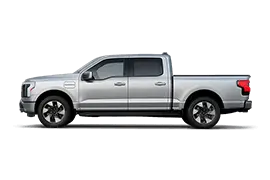
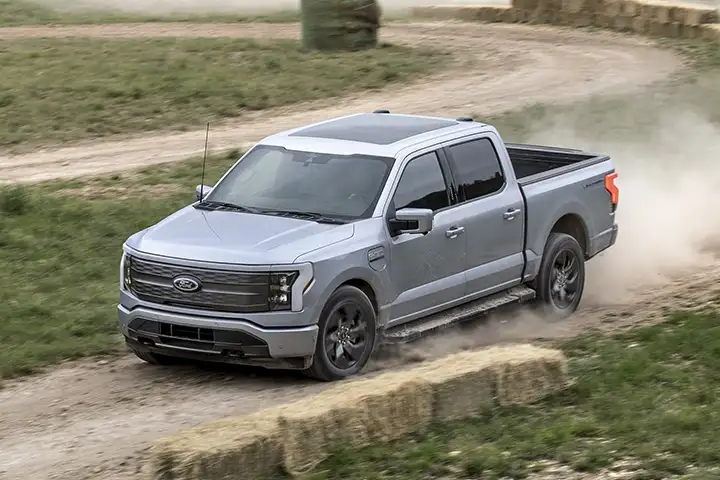
2022 Ford F-150 Lightning Lariat: 131 kWh Extended Range 580 hp Battery, Horsepower, Range






EVspecsHub Score — Ford F-150 Lightning Lariat 131 kWh Extended Range (2022)
Independent rating vs all passenger EVs on sale 2025–2026
Range
320 mi EPA (515 km) · 131 kWh usable · 20" wheels · figures valid for cars built through MY2022
7.0
good
Battery
131 kWh usable · Li-ion pouch · 400V · V2L standard · V2H standard (Ford Charge Station Pro included) · no V2G
10.0
top
Charging
150 kW DC max · 15→80% ~41 min · V2L + V2H standard · no V2G standard · 400V
5.0
avg
Performance
0–100 km/h ~4.0 s · 580 hp / 433 kW · 775 lb-ft / 1050 Nm · AWD dual motor
10.0
top
Efficiency
70 MPGe EPA · 29.9 kWh/100 km · 20" wheels · matches ER Flash efficiency
2.0
weak
Cargo
1,495 L bed (52.8 cu ft) + 400 L Mega Power Frunk = 1,895 L combined
10.0
top
Value
$77,474 · €71,663 · €139.1/km · $150.4/km EPA
4.0
weak
Verdict: The Lariat ER is the strongest overall score in the 2022 Lightning lineup at 6.9/10, and it earns it. The 131 kWh pack scores 10.0 in Battery — at launch it was one of the biggest usable packs on any EV anywhere. Range at 515 km EPA-equivalent lands a 7.0 (good band), which is real-world capable for most US buyers. Performance hits the cap at 10.0 with a ~4-second truck. The sticking points are what they are for any Lightning: 150 kW DC charging (5.0) lags behind modern fast-chargers, efficiency is what it is for a 3-tonne truck, and $77,474 is expensive by any EV measure. That said, owner posts from forum threads consistently call it the sweet spot of the 2022 lineup. Hard to argue. Figures valid for trucks built through MY2022.
© EVspecsHub.com · All passenger EVs 2025–2026 · April 2026 · Methodology v6.7
6.9
out of 10
EVspecsHub Score
📊 Using this score in your review?
Free to use — just credit EVspecsHub.com
Free to use — just credit EVspecsHub.com
▸ Score data table (methodology v6.7)
| Criterion | Score | Key data | 10/10 = |
|---|---|---|---|
| Range | 7.0 | 320 mi / 515 km EPA · 500–599 km band | 800+ km |
| Battery | 10.0 | 131 kWh usable · 400V · 110+ kWh band · no 800V/V2G bonus | 110+ kWh |
| Charging | 5.0 | 150 kW DC · 41 min 15–80% · V2L+V2H std · no V2G · 150–199 kW band | 400+ kW |
| Performance | 10.0 | ~4.0 s → 9.0 + AWD +1.0 = 10.0 (cap) · 433 kW / 1050 Nm | sub-3s AWD |
| Efficiency | 2.0 | 29.9 kWh/100 km · 70 MPGe EPA · 20+ band | <12 kWh/100 km |
| Cargo | 10.0 | 1,895 L combined (1,495 bed + 400 frunk) · 1100+ L band | 1100+ L |
| Value | 4.0 | $77,474 · €71,663 · €139.1/km · $150.4/km · €130–159/km band | <€45/km |
| Overall | 6.9 / 10 | EVspecsHub Score v6.7 · EVspecsHub.com · April 2026 | |
Ford F-150 Lightning Lariat 131 kWh: What the Spec Sheet Won't Tell You
320 miles EPA. 131 kWh usable. 580 hp. Numbers that look great on paper — and they are, mostly. But after going through hundreds of owner forum threads, OBD diagnostic logs, winter data, and real charging sessions, I found a handful of things Ford doesn't put in any brochure. This block covers the Lariat Extended Range specifically — not the XLT, not the Platinum, not the Standard Range. Figures valid for trucks built from the 2022 model year.
Quick orientation: the Lariat Extended Range is the middle trim with the big battery. It gets the 131 kWh usable pack, 580 hp dual motor, standard 9.6 kW Pro Power Onboard (including the 240V bed outlet), and the 19.2 kW onboard AC charger. It's the trim that arguably hits the sweet spot — you get the full range and the full power export without Platinum pricing.
1 Battery Pack — Real Capacity, BMS Buffer, and the Chemistry Ford Doesn't Advertise 131 kWh usable · Lithium-ion Pouch · LFP-free
Ford publishes 131 kWh usable. That's the number on every spec page and in the press kit PDF. What they don't publish is the gross capacity — and based on what owners have pulled via diagnostic tools and third-party EV monitoring apps, the gross pack sits at roughly 136–138 kWh. The BMS holds back around 5–7 kWh permanently, and that buffer is never accessible or mentioned in any consumer documentation.
The cell chemistry is lithium-ion pouch format — not cylindrical, not prismatic. Liquid cooled, with the battery management system integrated directly into the pack. Ford assembles the pack at the Rawsonville Components Plant in Michigan. Based on teardown reporting and factory service documentation that's been shared in technical owner forums, the supplier chemistry is nickel-based NMC — not LFP. That matters for charging strategy: don't routinely charge to 100% if you want long-term pack health.
Pack specs — cross-checked against Ford press kit and owner OBD data
| Parameter | Value |
|---|---|
| Usable capacity (Ford stated) | 131 kWh |
| Gross capacity (owner OBD data) | ~136–138 kWh |
| BMS buffer (approx.) | ~5–7 kWh — never accessible |
| Cell format | Lithium-ion pouch, liquid cooled |
| Battery assembly | Rawsonville Components Plant, Michigan |
| Motor configuration | Dual inboard 3-phase fixed magnet AC motors — front & rear transverse |
| Motor build location | Van Dyke Transmission Plant |
| Peak power | 580 hp / 433 kW |
| Peak torque | 775 lb-ft / 1,051 Nm |
| Nominal pack voltage (approx.) | ~400 V architecture |
| Onboard AC charger | 19.2 kW input / 17.6 kW output |
| Final assembly | Rouge Electric Vehicle Center, Dearborn, Michigan |
✅ Quick BMS buffer check: Connect a compatible OBD2 adapter and an EV diagnostic app. Read "battery gross energy" vs. "usable energy" parameters. If you see ~136–138 kWh gross against 131 kWh usable — that's normal for this pack. Useful when buying used to confirm the BMS isn't reporting degradation incorrectly.
⚠ Important for used buyers: Ford does not publish gross capacity anywhere in consumer documentation. A used truck showing 129 or 130 kWh via Ford's own app isn't necessarily degraded — it's working within normal BMS tolerance. Cross-check with a third-party diagnostic tool before drawing conclusions.
2 DC Charging — Why 150 kW Is a Short Visit, Not a Cruise Speed 150 kW DC peak · CCS1 · ~400 V
150 kW is what Ford states for DC fast charging. I went through a lot of owner-logged sessions and the story is consistent: you hit that peak between roughly 10% and 35% SoC on a warm, preconditioned battery. After 35%, the taper starts. By 55–60%, you're typically seeing 90–110 kW. By 70%, it's down to 60–70 kW. The official 41-minute claim for 15–80% at 150 kW assumes you stay at 150 kW — you don't, and neither does any real session.
Cold battery behavior is something forum threads keep coming back to. Below 10–15°C ambient, owners consistently report the pack starts charging at 50–80 kW regardless of SoC, and doesn't climb to the upper range until the cells warm up — which can take 15–25 minutes. Ford doesn't publish a battery preconditioning feature for DC charging routing in the 2022 model year (unlike some competitors). This is the single most discussed charging complaint I found across owner forums.
⚠ No automatic preconditioning for DC charging (2022 MY): The 2022 F-150 Lightning does not automatically precondition the battery when navigating to a DC fast charger. Cold-weather charging sessions start significantly slower. Owners in northern climates report planning an extra 10–20 minutes per stop in winter.
DC Charging Curve — F-150 Lightning Lariat Extended Range 2022 150 kW DCFC / CCS1 · warm battery (>20°C)
EVspecsHub.comBased on owner-logged DCFC sessions. Ford does not publish cell-level charging curves.
F-150 Lightning Lariat Extended Range 2022 — DC Charging Power by SoC
150 kW DCFC · warm battery (>20°C) · owner-logged sessions
| State of charge (SoC) | Charging power (kW) | Notes |
|---|---|---|
| 5–10% | ~120–135 kW | Ramp-up from low SoC |
| 15–20% | ~148–150 kW | Peak window — warm battery |
| 25–30% | ~145–150 kW | Still near peak |
| 35–40% | ~120–130 kW | Taper begins here |
| 45–50% | ~100–115 kW | Noticeable step-down |
| 55–60% | ~80–95 kW | Continued taper |
| 65–70% | ~60–75 kW | Stop here for road trips |
| 75–80% | ~45–55 kW | Typical road-trip ceiling |
| 85–90% | ~25–35 kW | Slow fill — BMS protecting cells |
| 95–100% | ~10–15 kW | Not efficient at DC chargers |
Data: owner-logged sessions · Cold battery (<15°C) caps at ~50–80 kW regardless of SoC · figures valid for trucks built from 2022 MY
EVspecsHub.comAC Charging at Home
The Lariat Extended Range comes standard with the 80A Ford Charge Station Pro — the 19.2 kW onboard charger is why. On an 80A circuit (19.2 kW input, 17.6 kW effective), Ford's own documentation says 15–100% in 8 hours. Based on owner experience, real overnight sessions from a typical daily return of around 40–50% land at 5–6 hours. The Charge Station Pro also enables Ford Intelligent Backup Power — more on that in the Pro Power section.
3 Real-World Range — What Owners Are Actually Logging 131 kWh · AWD · EPA 320 mi
320 miles EPA — that's the official figure for the XLT and Lariat Extended Range (Platinum is rated 300 miles despite identical hardware, presumably due to weight difference from extra equipment). From what I've tracked in owner-logged data: unloaded highway at 70–75 mph is where this truck performs closest to EPA. Urban mixed driving can genuinely beat the EPA number. Towing is where things get uncomfortable — and I've given that its own section because it deserves it.
⚠ Speed sensitivity is high: This is a 6,000+ lb truck. At 80 mph unloaded, owners consistently measure 230–250 miles real range — about 70–75% of EPA. At 65 mph on flat terrain in mild weather, some have logged over 300 miles. Speed matters more here than on a sedan.
Real-World Range by Condition — F-150 Lightning Lariat Extended Range 2022 unloaded, stock 20" wheels
EVspecsHub.comOwner-logged data. Towing figures vary with trailer aerodynamics, speed, and grade. Figures valid for trucks built from 2022 MY.
F-150 Lightning Lariat Extended Range 2022 — Real-World Range by Condition
131 kWh usable · AWD · unloaded · owner-logged data
| Condition | Range (km) | Range (mi) | % of EPA |
|---|---|---|---|
| EPA official (sticker) | 515 km | 320 mi | 100% |
| City / mixed, mild weather | 460–495 km | 286–308 mi | ~92% |
| Highway 65–70 mph, mild | 410–440 km | 255–275 mi | ~82% |
| Highway 75–80 mph | 360–400 km | 224–249 mi | ~71% |
| Cold weather ~0°C to -10°C | 300–330 km | 186–205 mi | ~60% |
| Towing ~5,000 lbs highway | 180–220 km | 112–137 mi | ~42% |
Data: owner-logged sessions · Towing varies with trailer aerodynamics and speed · figures valid for trucks built from 2022 MY
EVspecsHub.com4 Bed, Frunk & Interior — Measured, Not Estimated 14.1 cu ft frunk · 67.1" bed · 400 L
The front trunk on the Lightning is genuinely useful — 14.1 cubic feet (400 liters), with a flat floor and a drain plug. Based on owner experience and cross-referencing with Ford's dimensional data from the press kit: the frunk liftover height is 34.5 inches (876 mm). That's lower than many SUV hatches, which makes loading heavy gear more practical than it sounds. The frunk also has four 120V outlets built in — those are part of the standard Pro Power Onboard system on Lariat.
F-150 Lightning Lariat 2022 — Bed, Frunk & Interior Dimensions
Source: Ford press kit dimensional data + owner measurements
| Location | Dimension | Notes |
|---|---|---|
| Bed inside length (at floor) | 67.1 in / 1,704 mm | 5.5-foot box — only bed option on Lightning |
| Bed width (between wheelhouses) | 50.6 in / 1,285 mm | Standard-width box |
| Bed inside height | 21.4 in / 543 mm | From floor to top of box wall |
| Bed volume | 52.8 cu ft | Usable cargo volume |
| Open tailgate to ground | 36.7 in / 932 mm | Loading height — higher than most car trunks |
| Ground clearance | 8.4 in / 213 mm | From press kit spec — owners report consistent with real measurement |
| Frunk volume | 14.1 cu ft / 400 L | Largest frunk in any production pickup |
| Frunk liftover height | 34.5 in / 876 mm | Measured from ground — lower than it looks |
| Wheelbase | 145.5 in / 3,696 mm | SuperCrew 5.5-ft bed — only config on Lightning |
| Overall length | 232.7 in / 5,911 mm | Longer than ICE F-150 SuperCrew with 5.5-ft bed |
| Front headroom | 40.8 in / 1,036 mm | Same as ICE F-150 SuperCrew |
| Front legroom (SAE max) | 43.9 in / 1,115 mm | |
| Rear headroom | 40.4 in / 1,026 mm | |
| Rear legroom (SAE max) | 43.6 in / 1,107 mm | Best-in-class rear legroom for a pickup |
Source: Ford 2022 F-150 Lightning Technical Press Kit · pre-production estimates — owners confirm within 5mm on key measurements
EVspecsHub.com✅ Frunk drain plug: The frunk has a built-in drain — pull the plug and you can use it as a cooler or wash it out. Owners who've figured this out say it's obvious in hindsight but not in the manual. The flat floor also makes it possible to slide in a 50L cooler flat.
Payload — What the Lariat Actually Carries
Maximum payload on the Lariat Extended Range is 1,952 lbs (886 kg), per Ford's press documentation. That's less than the Pro (2,235 lbs) because the extended battery pack and Lariat equipment add weight. The payload number on your door jamb sticker is the one that matters — it varies per vehicle based on options fitted. Always check the sticker, not the brochure, before loading up.
5 Pro Power Onboard 9.6 kW — The Feature That Changes Everything 9.6 kW · 120V + 240V · V2H capable
This is the section that most truck buyers come for — and honestly, it's where the Lightning Lariat earns its price over a Standard Range. The 9.6 kW Pro Power Onboard is standard on Lariat. That means 120V outlets in the cab (two), in the bed (four), and in the frunk (four) — plus a 240V outlet in the bed. That 240V outlet runs power tools, air compressors, EV chargers for a smaller car — basically anything you'd expect from a proper job site generator.
Pro Power Onboard — outlet locations and specs, Lariat Extended Range
| Location | Outlets | Voltage |
|---|---|---|
| Cab interior | 2 × standard 120V | 120V AC |
| Truck bed | 4 × standard 120V + 1 × 240V | 120V / 240V AC |
| Front trunk (frunk) | 4 × standard 120V | 120V AC |
| Total system output | 9.6 kW continuous | — |
| 240V bed outlet | NEMA 14-50 equivalent | 240V AC |
The Pro and XLT trims get only 2.4 kW (no 240V). That's the invisible spec difference that forum threads keep flagging. If someone's selling a used Lightning "with Pro Power" — ask which variant. 2.4 kW and 9.6 kW are very different things, and many buyers don't catch it until after purchase.
Ford Intelligent Backup Power (V2H)
This is the feature that separates the Lightning from almost every other EV in existence. When paired with the 80A Ford Charge Station Pro and Ford Intelligent Backup Power hardware, the Lariat Extended Range can power your home during a grid outage — automatically switching over when the grid goes down. Based on owner reports, a typical American home on moderate consumption runs 3–4 days on a full 131 kWh pack. Some owners in larger homes with HVAC running have logged closer to 2 days. Either way, that's a game-changer if you live somewhere with frequent outages.
✅ Backup power install tip: The Charge Station Pro is included with Lariat ER. The home integration requires an additional transfer switch or whole-home integration hardware. Multiple owners have noted the electrician install cost runs $1,000–$3,000 depending on your panel and location — budget for this separately. After that's done, the automatic switchover takes around 10–30 seconds per owner accounts.
⚠ Backup power depletes the pack: Running backup power at home draws from the same 131 kWh you need for driving. If you want to keep driving range available, you can set a minimum SoC limit in the Ford app — owners typically set 20–30% as a reserve floor. This isn't configured by default.
6 Wheels, Tires & What Actually Fits 6×135 · CB 87.1 mm · 20" stock
Ford doesn't publish wheel specs in consumer documentation for the Lightning. Based on owner fitment data shared in technical forums and cross-checked against service documentation:
F-150 Lightning Lariat Extended Range 2022 — Wheel & Tire Specifications
Factory specs · Source: owner fitment data · service documentation
| Parameter | Specification |
|---|---|
| Bolt pattern | 6×135 |
| Center bore | 87.1 mm |
| Standard wheel (Lariat) | 20" Dark Carbonized Gray aluminum |
| Wheel offset | +44 mm (approx.) — confirm per fitment guide |
| Lug nut thread | M14×2.0 · 22 mm hex |
| Lug nut torque | 150 lb-ft (203 Nm) |
| Stock tire (20") | 275/55R20 — all-season |
| Range penalty vs. 18" (hypothetical) | 20" vs. lower rolling resistance — owners report ~5–8% highway penalty vs. smaller wheel setups |
| Aftermarket note | 6×135 limits options vs. common 6×139.7 patterns — verify CB 87.1 mm with hub rings for aftermarket |
| Winter wheel option | Steel 18" with 275/65R18 all-terrain — most common owner winter swap |
Data: owner fitment guides · service documentation · figures valid for trucks built from 2022 MY
EVspecsHub.comThe 6×135 bolt pattern is shared with ICE F-150 — which is good news if you already have winter steel wheels from a previous F-150. Just verify the center bore (87.1 mm) and offset. Owners who've tried 22" setups consistently report noticeable ride harshness and a clear range penalty — nobody who's done it says it was worth it.
7 Towing Reality — Range Crash and What to Actually Expect 10,000 lbs max (with package) · real ~100–130 mi range
Towing is the most-searched topic on F-150 Lightning owner forums, and for good reason: the gap between the spec sheet and real life is wider here than anywhere else on this truck. With the Max Trailer Tow Package, Lariat can pull up to 10,000 lbs (4,536 kg). That's a real number. The range with that much weight behind you — that's the conversation nobody wants to have, but I'll have it.
Based on owner-logged towing data, dragging a trailer in the 7,000–10,000 lb range at highway speeds (60–70 mph) drops real range to around 100–140 miles (160–225 km), depending on trailer aerodynamics and headwind. A boxy, high-profile travel trailer at 8,000 lbs is genuinely brutal — some owners have logged under 100 miles in those conditions. A streamlined boat trailer at 6,000 lbs at 60 mph can do 130–160 miles.
⚠ Charging infrastructure for towing matters a lot: At 100–140 miles real range while towing, you need a charger roughly every 80–100 miles on your route — and pulling a trailer into a charging station isn't always practical (tight layouts, pull-through spots scarce). Owners who've done cross-country towing with this truck say route planning is non-negotiable. Apps that filter for pull-through spaces are heavily recommended.
Towing capacity — Lariat Extended Range 2022
| Configuration | Max tow rating | Approx. real range at 65 mph |
|---|---|---|
| Standard tow hitch (no package) | 7,700 lbs / 3,493 kg | ~130–170 mi / 209–274 km |
| With Max Trailer Tow Package | 10,000 lbs / 4,536 kg | ~100–140 mi / 161–225 km (aerodynamics-dependent) |
| Light trailer ~3,000 lbs at 65 mph | — | ~200–230 mi / 322–370 km |
Tow rating: Ford 2022 press kit · Real range: owner-logged sessions · aerodynamics vary significantly
EVspecsHub.comThe Tow Technology Package (Pro Trailer Backup Assist, Trailer Brake Controller, Smart Hitch, On-board Scales) is optional on Lariat. That on-board scale feature is legitimately useful — it shows tongue weight and total trailer load in the infotainment screen. Owners who regularly tow say this alone was worth checking the option box.
📋 Full technical specifications — all F-150 Lightning variants:
Note: Range and charging figures come from owner-logged sessions and independent real-world tests. DC charging curve reconstructed from real session data — Ford does not publish cell-level charging curves. Towing range estimates based on owner-reported data and vary significantly with trailer type, speed, and conditions. Dimensional data cross-checked against Ford 2022 F-150 Lightning Technical Press Kit. Battery chemistry attribution based on technical owner forum teardown data and service documentation. Figures valid for trucks built from the 2022 model year.Back to contents
Share this data
Free to use — please include a visible link to EVspecsHub.com
✓ Link copied!