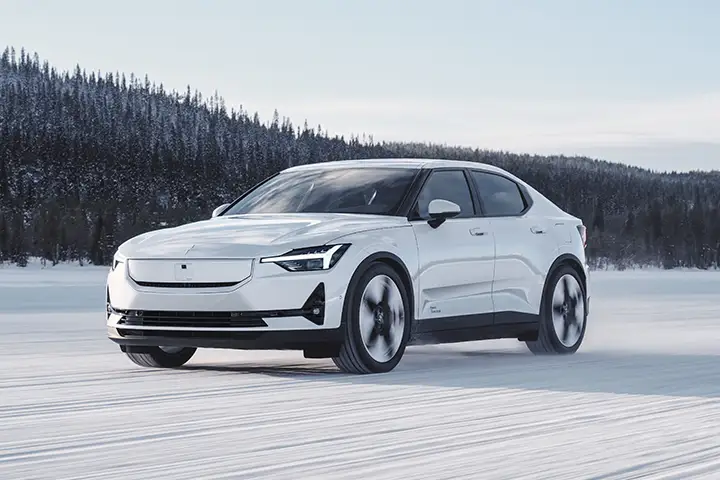
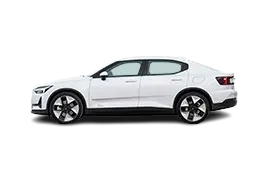
2024 Polestar Polestar 2 Standard Range Single Motor 69.0 kWh 272 hp Battery, Horsepower, Range
The 2024 Polestar 2 Standard Range Single Motor features a 69 kWh usable battery capacity (size) and a practical 532 km (331 mi) WLTP range. This efficient RWD model offers 200 kW (272 hp). All specs verified with official sources.
POPULAR cars…
Polestar Polestar 2
Standard Range Single Motor | 2024–
200 kW
Technical Data & Performance | |
| Model Years | 2024–present |
| Trim (Variant) | Polestar 2 - Standard Range Single Motor |
| Power (Horsepower) | 200 kW (272 hp) |
| Top Speed | 205 km/h (127 mph) |
| Torque | 490 Nm (361 lb-ft) |
| Acceleration | 6.4 sec (0–100 km/h) 6.4 sec (0–62 mph) |
| Drive | RWD Rear-wheel drive |
| Motor details | Permanent Magnet Synchronous Motor (PMSM) | Valeo Siemens |
| Motor code | BCBFH |
Battery & Charging | |
| Battery Capacity & Size | 67.0 kWh usable, 69.0 kWh gross |
| Max Range | 532 km (331 mi) / WLTP 670 km (416 mi) / CLTC |
| Consumption | 15.9 kWh/100 km |
| Battery Type | NCM (Nickel-Cobalt-Manganese) |
| Cell Format / Supplier | 24 Modules (Prismatic) | LG Chem |
| Battery Voltage | 400 V |
| Electrical Architecture | 400 V |
| Battery Updates | Chemistry Update (MY24): The 2024 refresh introduced NMC 811 chemistry. |
| V2L Supported | No |
| Heat pump | Yes | Optional (Plus Pack) |
| AC Home Charging | Type2 / 1-phase - 7.4 kW (Max Power) Type2 / 3-phase - 11 kW (Max Power) |
| DC Fast Charging | CCS2, 135 kW (Max Power) 28 min. (10–80%) |
Dimensions & Body | |
| Type | 5 door, Liftback |
| Seating capacity | 5 |
| Class | D-segment Liftback (EU) | Compact Executive (U.S.) |
| Length | 4606 mm (181.3 in) |
| Width | 1859 mm (73.2 in) |
| Height | 1479 mm (58.2 in) |
| Wheelbase | 2735 mm (107.7 in) |
| Ground Clearance | 151 mm (5.9 in) |
| Curb weight | 1944 kg (4286 lb) |
| Gross weight | 2390 kg (5269 lb) |
| Trunk Volume | 405 L (14.3 ft³) 1095 L (38.7 ft³) max |
| Towing | Unbraked: 750 kg (1653 lb), Braked: 1500 kg (3307 lb) |
| Drag Coefficient | 0.278 |
| Platform | CMA (Compact Modular Architecture) | co-developed by Volvo and Geely. |
|
Estimated Market Price * for reference only |
EUR 48,990 |
⚠️ Please note: actual vehicle specifications may vary depending on market, trim level, or available regional packages.
The Evolution of the Polestar 2: Key Changes and Specifications
Generation I (2020: Global Launch)
- Models & Motors (Launch Edition):
- Long Range Dual Motor: Debut configuration with a combined output of 300 kW (408 hp) and 660 Nm. All-wheel drive (AWD).
- Battery: 78 kWh total capacity (75 kWh usable). High-voltage 400V architecture using 27 modules.
- Platform: Built on the CMA (Compact Modular Architecture), sharing structural DNA with the Volvo XC40 but tuned for performance.
- Innovation: The Polestar 2 was the world’s first car to feature an infotainment system powered by Android Automotive OS with Google built-in — a milestone in connected mobility.
- Sustainability: Interior materials included vegan upholstery and recycled plastics, highlighting Polestar’s eco-conscious design philosophy.
2021–2022: Portfolio Expansion
- New Trim Levels: Introduction of Single Motor variants to reach a broader market.
- Standard Range Single Motor: 165 kW (224 hp) and 330 Nm. Front-wheel drive (FWD).
- Long Range Single Motor: 170 kW (231 hp) and 330 Nm. Front-wheel drive (FWD).
- Technical Updates: Introduction of a Heat Pump (optional in Plus Pack) that uses waste heat from the drivetrain to extend real-world range by up to 10% in cold climates.
- Performance Pack: Enhanced driving dynamics with Brembo brakes, Öhlins DFV dampers, and distinctive gold accents.
- Fact: Polestar emphasized over-the-air (OTA) software updates, allowing continuous improvement of range, performance, and infotainment features.
2023: Battery Upgrade
- Standard Range Update: Battery capacity increased from 64 kWh to 69 kWh (CATL cells), with DC charging speed raised from 116 kW to 130 kW.
- Efficiency: Improved energy density and charging curve optimization, reducing charging times and enhancing long-distance usability.
2024: The Major Drivetrain "Flip" (Technical Facelift)
- The "RWD" Revolution: Single motor models switched from Front-Wheel Drive to Rear-Wheel Drive (RWD), significantly improving handling and traction.
- New Motors & Power:
- Single Motor (RWD): Power increased to 220 kW (299 hp).
- Dual Motor (AWD): Re-balanced system with a new rear-biased power delivery, outputting up to 310 kW (421 hp) or 350 kW (476 hp) with Performance Pack.
- Battery Update: Long Range models received a new 82 kWh battery (CATL) with improved chemistry, increasing DC charging speed to 205 kW. Standard Range stayed at 69 kWh but with improved efficiency.
- SmartZone: The front grille was replaced by the SmartZone — a smooth panel housing radar and camera systems, symbolizing the shift from “breathing” to “seeing.”
- Design Refresh: Updated front fascia, new wheel designs, and refined interior trims emphasized Polestar’s premium positioning.
2025–2026: Refinement & Efficiency
- Battery Standardization: The Standard Range Single Motor was upgraded to a 70 kWh battery (CATL), pushing WLTP range beyond 550 km.
- Hardware Upgrade: Introduction of a new Qualcomm Snapdragon processor for the infotainment system, doubling interface speed and responsiveness.
- Audio Evolution: Premium audio option upgraded to a Bowers & Wilkins system (1,350 watts), replacing Harman Kardon.
- Limited Editions: BST Edition 270/230 offered lowered suspension, unique chassis tuning, and exclusive design cues for enthusiasts.
- Global Availability: Europe and China offered the full range of trims, while North America focused on high-output Long Range Dual Motor configurations.
Common Issues and Problems with the Used Polestar 2
First Generation (2020 – Present)
TCAM Connectivity & Software Glitches
The most widely reported issue is failure of the TCAM (Telematics and Connectivity Antenna Module), responsible for GPS, LTE, Bluetooth, and the digital key. Faults can cause loss of connectivity, block OTA updates, and even disable key fobs.
Solutions: A temporary fix is a TCAM reset (holding the defroster button for 20 seconds until the SOS light flashes). Persistent faults require dealer replacement of the TCAM battery or module. Ensuring the car runs the latest P2.x/P3.x software is critical.
Propulsion System & Drivetrain Faults
Early 2020–2021 models sometimes show “Propulsion System Service Required”. Causes range from software conflicts to inverter or BECM issues, occasionally triggering limp mode or shutdown.
Solutions: Polestar issued recalls for inverter and high-voltage contactor replacements. Buyers should confirm all recalls and TSBs are completed. Many cases resolve with software recalibration.
Suspension Knocking & Brake Noise
Owners report front strut bearing noise (clicking or grinding at low speeds). Performance models with Öhlins dampers may produce a normal “hiss.” Rear brake squeal is common due to regenerative braking.
Solutions: Dealers replace strut bearings with upgraded parts. Brake squeal is usually solved by high-friction braking to clean discs.
Drive Axle & CV Joint Vibrations
Dual Motor variants sometimes show acceleration shudder, nicknamed “wheel of fortune” vibration. This is linked to front drive axles or CV joints with excessive play or poor lubrication.
Solutions: Polestar replaces axle assemblies under warranty. Test drives should include rapid acceleration (30–70 km/h) to check for vibrations.
Conclusion
The Polestar 2 is a premium EV with strong driving dynamics, but early years (2020–2022) are more prone to connectivity faults, drivetrain warnings, and suspension noises. OTA updates have stabilized software, and recalls addressed inverter/contactors. When buying used, prioritize cars with full service history at Polestar or Volvo dealers. Despite these issues, Polestar’s proactive fixes and robust build quality make the Polestar 2 one of the most reliable choices in the premium EV segment.
* Disclaimer: The information presented here is compiled from owner discussions in online communities, forums, and various open public sources. The accuracy, completeness, and reliability of this data cannot be guaranteed, and it should be used for informational purposes only.
Frequently Asked Questions FAQ about the Polestar 2 Standard Range Single Motor | max Range, Battery size
The Polestar 2 offers a range of up to 532 km (331 mi) / WLTP under WLTP standards, depending on driving conditions and trim.
It supports DC fast charging up to 135 kW, reaching 10–80% in about 28 minutes at compatible stations. AC charging is 11 kW from a home wallbox.
No, V2L (Vehicle-to-Load) or bidirectional charging is not supported in the standard model.
The 2024 Polestar Polestar 2 Standard Range Single Motor has a trunk capacity of 405 L (14.3 ft³) standard, expandable to 1095 L (38.7 ft³) with rear seats folded. Frunk availability hasn't been officially confirmed yet.
The 2024 Polestar Polestar 2 Standard Range Single Motor measures 4606 mm (181.3 in) in length, 1859 mm (73.2 in) in width, and 1479 mm (58.2 in) in height. The wheelbase is 2735 mm (107.7 in).
The ground clearance of the Polestar 2 is 151 mm (5.9 in).
Unbraked trailer: 750 kg (1653 lb). Braked trailer: 1500 kg (3307 lb).
The Polestar 2 features a motor (BCBFH) delivering 200 kW (272 hp) and 490 Nm (361 lb-ft) of torque.
2024 Polestar Polestar 2 Standard Range Single Motor common issues and main problems:
- TCAM Connectivity & Software Glitches
- Propulsion System & Drivetrain Faults
- Suspension Knocking & Brake Noise
- Drive Axle & CV Joint Vibrations