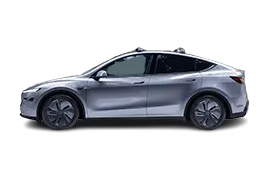
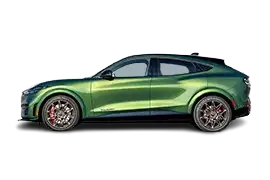
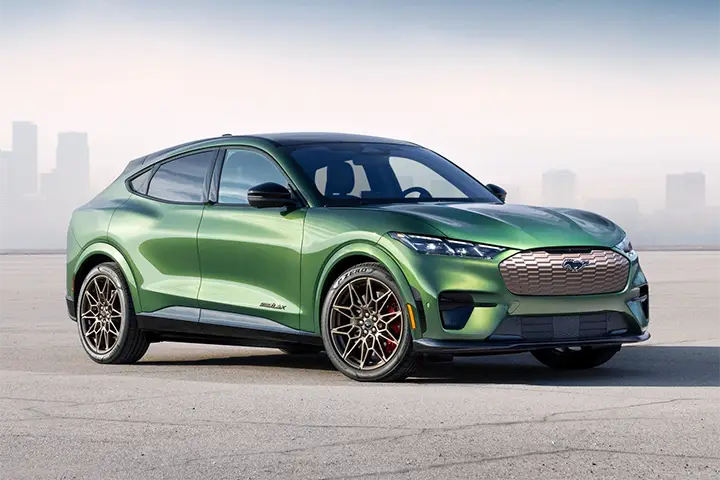
2020 Ford Mustang Mach-E Premium AWD - Extended Range 98.8 kWh 346 hp Battery, Horsepower, Range
The Ford Mustang Mach-E Premium AWD delivers balanced electric performance and range with an 91.0 kWh usable lithium-ion battery capacity (Extended Range) 540 km (336 mi) WLTP range. All specifications verified against official Ford data and type‑approval documents.
Ford Mustang Mach-E Generation Guide: What Actually Changed and Why It Matters
Ford kept the same body for the entire Mach-E run. From the outside, a 2021 and a 2025 are nearly identical. Inside — two hardware overhauls, a full battery chemistry swap on base models, and one recall that still shapes how people evaluate the early cars. I went through all of it to make this actually useful for buying decisions, not just a spec list.
1 MY21 — Launch (deliveries from late 2020) First Series
First deliveries December 2020, built at Cuautitlán, Mexico — same plant as today. Won 2021 North American SUV of the Year. The hardware was solid enough for the era; some of the decisions look worse in hindsight.
Two battery sizes: SR — 75.7 kWh gross / 68 kWh usable, NCM pouch cells from LG Energy Solution. ER — 98.8 kWh gross / 88 kWh usable, same chemistry. Both 400V.
Charge port: CCS1 — standard for US at the time. No NACS until 2025.
DC charging: SR 115 kW, ER 150 kW. No battery preconditioning — cold-pack sessions opened well below rated speeds.
Rear motor: Magna-supplied. SR RWD 266 hp / 317 lb-ft (430 Nm). GT 480 hp / 600 lb-ft (814 Nm) AWD. Front motor on AWD from BorgWarner.
Heat pump: No. Resistive heating only — and this stayed that way until 2025.
⚠ HVBJB recall — the thing used buyers must check first. The High Voltage Battery Junction Box on ER and GT models built before May 2022 had undersized contactors that overheated under repeated DC fast charging and hard acceleration. Contactors would either weld shut or fail to close — the latter causing immediate power loss while driving. Ford issued a software band-aid (22S41) in mid-2022, then a proper hardware recall (23S56) in late 2023 requiring the battery pack to be dropped and the junction box replaced. Three generations of HVBJB parts exist. If you're buying a used 2021–22 ER or GT: confirm hardware recall 23S56 is completed, not just the software update. They are different repairs.
2 MY22 & MY23 — One Hidden Change That Matters 2022–2023
MY22 was cosmetic only — nothing powertrain-relevant. MY23 had one genuinely important mid-year shift that Ford didn't announce loudly, and I'd argue most buyers still don't know about it.
LFP battery on SR from July 2023: CATL prismatic LFP replaced LG NCM on Standard Range builds. Usable capacity: 68 → 72 kWh. DC peak: 115 → 150 kW. 10–80%: ~38 → 33 minutes. LFP can charge to 100% daily without the degradation concerns of NCM. Window sticker reads "72KWH USABLE STD LFP BATT." ER stayed NCM throughout.
Thermal system redesign (mid-2023): Ford quietly reworked the cooling system with waste heat recovery. No press release. Engineers described it as more impactful than a heat pump at highway speeds. Worth knowing when comparing early vs. late 2023 cars.
Charging curve OTA fix: Original cars dropped from ~80 kW to 11–12 kW above 80% SOC — a wall, not a taper. Updates starting with recall 21P22 improved post-80% to 40–45 kW. Much better. Not what you got at launch.
A "2023 Job 1" and a "2023 Job 2" are meaningfully different cars. The production date on the window sticker is how you tell them apart.
3 MY24 — The Car Ford Should Have Built in 2021 2024
This is where people who'd been watching the Mach-E from a distance started paying attention. I keep coming back to MY24 when someone asks which used Mach-E to buy — the powertrain finally caught up with where it should have been.
New in-house rear motor — biggest single change in the model's history
Ford replaced the Magna unit with its own design across all trims. Lighter, more torque: SR RWD 317 → 387 lb-ft (430 → 525 Nm), ER AWD 428 → 500 lb-ft (580 → 678 Nm). Horsepower barely moved — torque is where it's felt. GT got a software "Performance Upgrade" pushing torque to 700 lb-ft (949 Nm) and 0–60 to 3.3 seconds — quicker than the old GT Performance Edition.
Unified Thermal Model: Ford mapped every high-current component — motor cabling, inverter, stator, battery bus bars, HVBJB contactors — into a single coordinated thermal model in the PCM. This is what eliminated the 5-second full-power limit that plagued earlier cars on track. Not a motor thing alone — motor and software working together.
Charging: ER 10–80% dropped from ~45 to 36 minutes. Confirmed by Ford engineers at the 2024 Seattle media event — improvement came from the motor's thermal characteristics combined with the unified model.
Range: All trims up 10–20 miles EPA. ER RWD Premium: 320 miles (515 km).
Rally trim on sale: AWD, 480 hp / 700 lb-ft (949 Nm), MagneRide, rally suspension, 1 inch more ground clearance, aluminum underbody shield. California Route 1 dropped.
✅ MY24 is the used sweet spot for ER buyers. New motor, unified thermal management, no HVBJB risk, 9 minutes faster charging than any earlier ER car. Build date from late 2023 is the line to look for.
4 MY25 — Heat Pump. Finally. Current
After four years of the same complaint in every owner forum, the 2025 Mach-E gets a heat pump. That's the headline. Ford's delay made engineering sense: ~$1,000 cost addition for under 7% range improvement at highway speed — hard to justify until competitor pressure made it unavoidable. Worth knowing why it took this long, because it explains the tradeoff that came with it.
Heat pump standard on all trims — required shrinking the frunk to fit. Owners upgrading from earlier cars noticed immediately. Worth it in cold climates; less obvious in warm ones.
SR battery: 72 → 73 kWh usable. EPA SR RWD: 250 → 260 miles (402 → 418 km). Fourth SR capacity bump in the model's life: 68 → 70 → 72 → 73 kWh.
NACS adapter ($200 factory option): Native port still CCS1, but the adapter unlocks Tesla Supercharger access — 12,000+ stalls in North America.
Price cuts up to $4,000: Select now from $36,495 — cheapest the Mach-E has been.
Key changes by model year — parameters that actually moved
Parameter
MY21–22
MY23 Job 2
MY24
MY25
SR battery / usable
NCM (LG) / 68 kWh
LFP (CATL) / 72 kWh
LFP / 72 kWh
LFP / 73 kWh
Rear motor
Magna (external)
Magna
Ford in-house
Ford in-house (refined)
SR RWD torque
317 lb-ft (430 Nm)
317 lb-ft
387 lb-ft (525 Nm)
387 lb-ft
ER 10–80% charge
~45 min
~45 min
~36 min
~36 min
Heat pump
No
No
No
Yes — standard
NACS access
No
No
No
Adapter ($200)
ER RWD EPA range
300 mi (483 km)
303 mi (488 km)
320 mi (515 km)
320 mi (515 km)
GT 0–60 mph
3.8 s
3.5 s (GT PE only)
3.3 s (Perf. Upgrade)
3.3 s
HVBJB recall risk
Yes (ER/GT pre May-22)
No
No
No
Unchanged throughout: body shape, 15.5" touchscreen, CCS1 native port, Cuautitlán production. ER NCM (LG) unchanged — only SR switched chemistry.