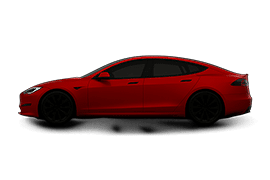
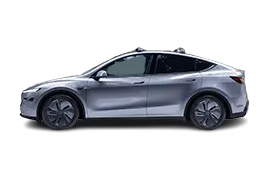
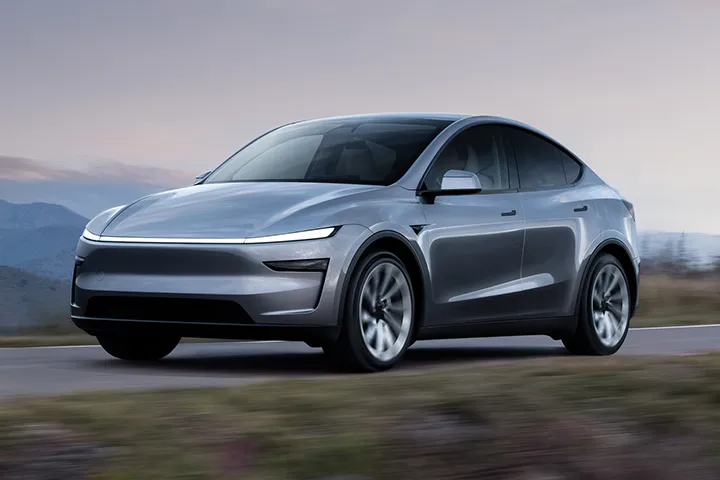
2025 Tesla Model Y Performance AWD (Juniper) 82 kWh 514 hp Battery, Horsepower, Range






EVspecsHub Score — Tesla Model Y Performance AWD 79 kWh (2025 Juniper)
Independent rating vs all passenger EVs on sale 2025–2026
Range
580 km WLTP · NMC ~82 kWh gross · 21" wheels
7.0
good
Battery
~79 kWh usable · NMC · 400V · no V2G
6.0
avg
Charging
~250 kW DC max · 400V · no V2L/V2H/V2G
7.0
good
Performance & Dynamics
0–100 km/h · 3.5 s · 461 kW · AWD · adaptive dampers
10.0
top
Efficiency
16.2 kWh/100 km WLTP · 21" wheel penalty vs LR
5.0
avg
Cargo
854 L boot · 117 L frunk · 971 L combined
8.0
good
Value
£61,990 · ~€72,500 · €124.9/km · $133.9/km WLTP
4.0
weak
Verdict: The Performance is the only Model Y that hits the 10.0 cap on Performance & Dynamics — 3.5 s to 100 km/h, 461 kW, adaptive dampers that owners in forum threads say genuinely transform the handling versus the regular AWD. Range moves up to 7.0 — 580 km is above average regardless of the 21" wheel tax. Efficiency at 16.2 kWh/100 km scores a fair 5.0. Value lands at 4.0 under the revised scale — at €124.9/km it's still firmly in the weak band, Porsche Macan EV money without 800V or any V2x. Pure performance car wearing an SUV badge.
© EVspecsHub.com · All passenger EVs 2025–2026 · March 2026 · Methodology v6.7
6.7
out of 10
EVspecsHub Score
📊 Using this score in your review?
Free to use — just credit EVspecsHub.com
Free to use — just credit EVspecsHub.com
▸ Score data table (methodology v6.7)
| Criterion | Score | Key data | 10/10 = |
|---|---|---|---|
| Range | 7.0 | 580 km WLTP · 500–599 km band | 800+ km |
| Battery | 6.0 | ~79 kWh usable · NMC · 400V (no bonus) · 70–79 kWh band | 110+ kWh |
| Charging | 7.0 | ~250 kW DC · 400V · no V2L/V2H/V2G · 250–299 kW band | 400+ kW |
| Performance & Dynamics | 10.0 | 3.5 s → 9.0 + AWD +1.0 = 10.0 (cap) · 461 kW · adaptive dampers | sub-3s AWD |
| Efficiency | 5.0 | 16.2 kWh/100 km WLTP · 16.0–16.9 band | <12 kWh/100 km |
| Cargo | 8.0 | 971 L combined (854 boot + 117 frunk) · 800–949 L band | 1100+ L |
| Value | 4.0 | £61,990 · ~€72,500 · €124.9/km · $133.9/km · €110–129/km band | <€45/km |
| Overall | 6.7 / 10 | EVspecsHub Score v6.7 · EVspecsHub.com · March 2026 | |
Tesla Model Y Performance AWD 2025 (Juniper): The One That Finally Got Adaptive Suspension — and V2L
580 km WLTP. 306 miles EPA. 250 kW DC. 79 kWh usable. The Performance Juniper arrived in August 2025 — months after the LR variants — and it's a genuinely different car underneath. Bigger pack, new rear motor, adaptive dampers, V2L/V2H, 16" QHD screen. I went through first-drive reviews, owner forum threads, and technical spec breakdowns to pull together what's actually different about this trim compared to everything else in the Juniper lineup.
One thing that catches people right away: the Performance Juniper uses a different, larger pack than the LR AWD. The LR AWD has 75 kWh usable. This one has 79 kWh usable from an 82 kWh gross pack — and despite weighing 2,108 kg (4,648 lb) on 21" Arachnid 2.0 wheels, it still nearly matches the LR AWD on highway range. That range gap used to be huge. It isn't anymore.
1 Battery Pack — Larger LG 5M Pack, EU vs US Output Split EU · LG 5M NMC · ~82 kWh gross US · Panasonic NCA · ~82 kWh gross
The Performance Juniper uses the updated LG 5M pack — the same designation confirmed through owner teardown posts. Gross capacity is ~82 kWh; usable is 79 kWh. That's 4 kWh more usable than the LR AWD Juniper. The LG 5M cells are an evolution of the M50 used in LR variants, with ~5 kWh more capacity added through cell-level improvements. One forum member broke down the numbers: "Only a 6-mile EPA range gap between LR AWD and Performance now. On 21" wheels. That's wild — the pack is doing real work here."
Pack and motor specs — confirmed from press releases
| Parameter | EU (Berlin / Shanghai) | US (Fremont) |
|---|---|---|
| Pack reference | LG 5M — NMC 2170 cylindrical | Panasonic NCA — 2170 cylindrical |
| Gross capacity | ~82 kWh | ~82 kWh |
| Usable capacity | 79 kWh | 79 kWh |
| Pack config | 400 V architecture · cylindrical 2170 cells | |
| Rear motor | Performance 4DU — same unit as Model 3 Performance | |
| Front motor | AC induction | |
| Combined output (EU Berlin) | 338 kW (460 hp) / 741 Nm (547 lb-ft) | 375 kW+ / 741 Nm (547 lb-ft) |
| 0–100 km/h (0–60 mph) | 3.5 sec (2.9 sec with rollout, Tesla claimed) | |
| Top speed | 250 km/h (155 mph) | |
| Kerb weight | ~2,108 kg (4,648 lb) — ~130 kg heavier than LR AWD | |
| Wheels (standard) | 21" Arachnid 2.0 — staggered: 255/35R21 front / 275/35R21 rear | |
| Lowered ride height vs LR | ~10–15 mm lower stance | |
The EU power figure — 338 kW (460 hp) — looks lower than the 393 kW (534 hp) of the pre-Juniper Performance. Tesla explains this as 32% more peak power and 16% more torque on the new motor, plus 22% better sustained continuous power. The number on the spec sheet dropped because the new 4DU motor is calibrated differently, not weaker. First-drive impressions consistently say it feels faster in the real world than the old car, especially mid-corner acceleration.
⚠ EU vs US power gap: Berlin-built EU cars make 338 kW (460 hp). US Fremont-built cars deliver noticeably more due to the Panasonic pack's higher peak current output. Same car, different factories, different peak numbers. Tesla doesn't clarify this on the configurator for either market.
✅ Pack chemistry: NMC/NCA — not LFP. Keep daily charge limit at 80%. Charge to 100% only before long trips, then drive immediately. The Performance pack holds more energy than LR variants and will need the same NMC care. Daily 100% charges are for the Standard RWD with its LFP pack — not this car.
2 DC Charging — 250 kW Peak, V2L/V2H, and What Changes Post-Track EU · CCS2 · V2L adapter required US · NACS · V2L adapter required
250 kW peak DC — same as LR AWD. With a slightly larger pack, the 10–80% window is around 28 minutes rather than 27. The charging curve is similar to the LR AWD with the same general taper from peak down through 80%. One practical difference from track use: arrive at a Supercharger with a thermally loaded battery after a spirited drive and peak speed may be throttled while the pack cools — typically recovers within 10 minutes.
The bigger charging story for this trim is V2L and V2H. The Performance Juniper is the first Model Y to officially support bidirectional charging. Output via the Tesla Outlet Adapter: up to 11.5 kW (120V/240V). V2H requires a compatible bidirectional inverter and hardware setup. Tesla confirmed the feature in October 2025; software enabling came through OTA updates in late 2025. An owner who set it up for backup power during a grid outage posted: "Powered my fridge, lights, and router for 18 hours on a 40% charge. This is why I bought Performance instead of LR."
⚠ V2L hardware is NOT included in the box. The Tesla Outlet Adapter that enables V2L is sold separately. Without it, V2L does nothing even though the hardware is in the car. Budget for the adapter before delivery day. V2H requires additional inverter hardware beyond that.
DC Charging Curve — Model Y Performance AWD Juniper 2025 V3 Supercharger · warm preconditioned battery · LG 5M / Panasonic NCA
EVspecsHub.comBased on owner-logged sessions. Navigate to Supercharger to activate battery preconditioning. Post-track sessions may show reduced peak speed until pack temperature drops.
Tesla Model Y Performance Juniper 2025 — DC Charging Power by SOC
V3 Supercharger · warm preconditioned battery · LG 5M NMC / Panasonic NCA
| SOC | Power (kW) | Notes |
|---|---|---|
| 5% | ~195 kW | Ramp-up from low SoC |
| 10% | ~238 kW | Approaching peak |
| 20% | ~248 kW | Peak window — warm pack |
| 30% | ~222 kW | Taper begins |
| 40% | ~192 kW | Step-down continues |
| 50% | ~162 kW | Mid-range taper |
| 60% | ~128 kW | Continued drop |
| 70% | ~88 kW | Taper continues |
| 80% | ~52 kW | Typical road-trip stop point |
| 90% | ~28 kW | BMS protecting cells near full |
| 100% | ~8 kW | Not recommended for daily — NMC/NCA pack |
Cold battery (<15°C / 59°F) caps at ~80–100 kW · Post-track: pack may throttle to 150–170 kW until temp drops · Navigate to Supercharger for preconditioning
EVspecsHub.com3 Real-World Range — How 21" Wheels and 2,108 kg Change the Numbers EU · WLTP 580 km US · EPA 306 mi
580 km WLTP on 21" Arachnid 2.0 wheels. The LR AWD gets 586 km on the same test with 19" Gemini wheels. That gap used to be enormous on the old generation — now it's 6 km. The larger 79 kWh pack is doing the work of compensating for the heavier wheels, the bigger tyres, and the 130 kg weight penalty. At motorway speeds owners report 390–430 km (242–267 mi) is realistic — roughly 65–70% of WLTP, consistent with every other SUV in this class at sustained highway pace.
⚠ Staggered tyres — no rotation possible. The 255/35R21 front and 275/35R21 rear are different sizes. You cannot rotate them front-to-back. Winter tyre planning means buying a separate set on new wheels — 19" or 20" in a square (same size all round) setup. Book this before the first cold snap, not during it.
Real-World Range by Condition — Model Y Performance AWD Juniper 2025
EVspecsHub.comCold-highway modelling (-10°C worst case) · motorway figures from independent test-drive reports and owner forum data · Actual range varies with driving style, HVAC load, and Insane/Sport mode usage.
4 Adaptive Dampers — What Standard vs Sport Actually Feels Like
Every previous Model Y Performance was criticised for a harsh, crashy ride on anything less than smooth tarmac. The Juniper fixes that with hardware-controlled adaptive dampers. Standard mode is where most people will live day to day. One owner who traded a 2020 Model 3 Performance for the Juniper Y put it bluntly after 1,000 miles: "The new suspension is the star of the show. This is like riding on a cloud compared to my M3P, which was a notoriously rough ride."
Switch to Sport and everything tightens up noticeably — the dampers stiffen, body roll drops, and the car feels planted on fast corners. An Australian reviewer summed it up well: in Sport it "carries frightening amounts of speed through bends" and "feels like it's on rails." The three steering modes (Comfort, Sport, Sport+) add another layer — Sport+ reaches something close to BMW-level steering weight, and the feedback, while not quite analogue, is significantly more communicative than the old generation.
⚠ Standard mode is still firm by SUV standards. Multiple reviewers noted that even in Standard the dampers don't make this a soft crossover ride. One German road test mentioned cobblestones still produce a slight pitching sensation. If you're expecting full luxury SUV compliance in Standard, it's better than before but still biased toward handling over comfort. The LR AWD in contrast is tuned for maximum compliance.
✅ Stability Assist — Reduced mode: The Performance Juniper has a Reduced Stability Assist mode that allows the rear to step out more before intervention. It retains essential safeguards but makes the car genuinely explorable near its limits. Standard mode is what you want in day-to-day driving; Reduced is what you want on a closed track or an empty mountain road.
5 What's Exclusive to This Trim and What Owners Found After Delivery
16" QHD Touchscreen — First in Any Tesla
The Performance Juniper is the first Tesla ever sold with a 16-inch QHD (quad-HD) centre display. Up from 15.4" and standard HD resolution. The difference in sharpness is visible — especially at night when the ambient lighting system interacts with the UI. One forum member who owned the old LR Juniper before switching noted: "The screen makes the LR car feel last-generation when you're sitting in both back-to-back." Whether future OTA updates differentiate the experience between 15.4" and 16" QHD units is a question that's already being debated in owner forums.
Performance-Exclusive Interior
Carbon fibre dashboard and door trim inserts. Aluminium pedals. Front seats with power recline, heating, ventilation, and power-adjustable thigh support. Rear heated and power-reclining seats. These are not available as options on LR variants — they're hardware exclusive to this trim. The seat thigh support is the one that gets specifically praised by taller owners who previously found Tesla's seats unsupportive on long drives.
21" Arachnid 2.0 — The Kerb Damage Reality
The Arachnid 2.0 wheels protrude slightly beyond the tyre shoulder. Any kerb contact leaves a visible mark — multiple reviewers and owners flagged this. If you live in a city or park in tight spots regularly, budget for alloy repair. Buy a separate 19" winter wheel set before the first cold snap — the staggered summer tyres are not interchangeable front-to-rear and should come off for winter use in any climate that sees regular snow or ice.
One Brake Noise — Reproduced in Multiple Cars
An InsideEVs Germany test reported a loud bang from the suspension area under hard braking and strong acceleration. Tesla's service team examined the car during the test and could not reproduce or explain it. Multiple first-drive accounts mention a similar noise, so it's not one car. Whether this is a known issue with an OTA fix or a hardware characteristic is unclear at the time of publication. Worth documenting with Tesla service if you experience it.
Rear Visibility — Smaller Rear Window
A 1,000-mile owner report specifically called out the rear window size as a design concern. The Juniper Y's rear window opening is narrower than the previous generation due to the bodywork changes. Tinting the rear glass further reduces visibility. If you rely heavily on your rearview mirror rather than cameras, this is worth testing before committing.
📋 Full technical specifications — all Model Y Juniper variants:
Note: Pack specification (LG 5M, 82 kWh gross, 79 kWh usable) from owner forum breakdowns. EU vs US power output from Tesla EU and US press releases. Charging data from owner-logged sessions. Range figures from independent first-drive reviews . Adaptive damper and suspension impressions from first-drive reviews and owner forum posts at TMC and Tesla Owners Online. V2L / V2H confirmation from Electrek and Tesla customer communications (October 2025). Data compiled as of March 2026.Back to contents
Share this data
Free to use — please include a visible link to EVspecsHub.com
✓ Link copied!